The 1970s File Feature
Gimme Shelter
Grand Funk Railroad's "Gimme Shelter": Hard Rock Ambition Meets the Stones' Dark Masterpiece Note: "Gimme Shelter" was written and originally recorded by the…
01 The Story
Grand Funk Railroad's "Gimme Shelter": Hard Rock Ambition Meets the Stones' Dark Masterpiece
Note: "Gimme Shelter" was written and originally recorded by the Rolling Stones for their 1969 album Let It Bleed. This entry concerns the cover version recorded and released by Grand Funk Railroad in 1971 on Capitol Records.
By 1971, Grand Funk Railroad had established themselves as one of the most commercially successful and critically divisive rock acts in America. The Flint, Michigan power trio, consisting of Mark Farner on guitar and vocals, Mel Schacher on bass, and Don Brewer on drums, had spent the previous two years selling out arenas and generating record-setting advance ticket sales while receiving some of the most withering notices in mainstream rock criticism. Their music was loud, direct, and built for large spaces, and their audience responded with an enthusiasm that suggested the critical community's contempt was simply beside the point.
Their decision to record a version of "Gimme Shelter" was announced both by the stylistic logic of their catalog and by the song's particular appropriateness to the hard rock idiom. The Rolling Stones' original, recorded at Olympic Sound Studios in London in 1969 with Merry Clayton delivering one of the most extraordinary guest vocal performances in rock history, was already understood as a landmark of dark, apocalyptic rock. Mick Jagger and Keith Richards had written the song in a period of mounting social anxiety, capturing the sense of a world coming apart at multiple seams simultaneously.
Grand Funk Railroad released their version of "Gimme Shelter" in 1971 on Capitol Records, the label that had been distributing their recordings since their debut. The band's approach to the song was characteristic of their overall aesthetic: amplified to arena scale, rhythmically blunt, and driven by Mark Farner's raw, straining vocal delivery. Where the Stones' original achieved its unsettling quality through a combination of slide guitar, Merry Clayton's operatic vocal escalation, and a sense of coiled menace, Grand Funk's version traded that menace for sheer volume and physical impact.
Producer Todd Rundgren, who worked with Grand Funk during a particularly productive period of their career, had a reputation for imposing a degree of sonic discipline on acts that sometimes struggled with it. His involvement with the band's recordings brought a tighter focus to their sound without fundamentally altering the power-trio directness that was their commercial calling card. The cover of "Gimme Shelter" reflected this balance, retaining the song's essential darkness while delivering it through the band's characteristic sonic framework.
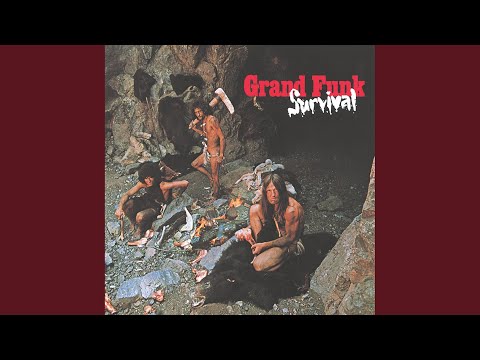
The recording appeared on the album Survival, released in 1971, which reached number six on the Billboard 200 album chart. The album demonstrated Grand Funk's continued commercial strength during a period when many critics had predicted their popularity would be short-lived. Instead, the band continued to sell in quantities that made them a major force in American rock, even as the rock press largely ignored or dismissed their work.
Grand Funk's engagement with the Rolling Stones material reflected a broader pattern in early 1970s rock, in which American hard rock and heavy rock acts frequently recorded versions of British Invasion and late-1960s rock catalog material, filtering it through a heavier, more amplified aesthetic suited to the emerging concert hall and stadium rock format. The Stones' song, with its thick guitar riff and apocalyptic lyrical content, was a natural vehicle for this treatment.
The band's fanbase, which skewed toward working-class American teenagers who responded to the physicality and directness of heavy rock, embraced the recording as they had embraced the band's original material. Grand Funk had famously sold out Shea Stadium in 1971, reportedly beating the Beatles' advance ticket sale record for the same venue, and their live performances consistently drew enormous crowds across the Midwest and throughout the country.
Critical reception of the "Gimme Shelter" cover followed the predictable pattern for Grand Funk at this period: largely ignored by the mainstream rock press, enthusiastically received by the audience. The gap between critical opinion and commercial reality that defined Grand Funk's career was nowhere more evident than in this period, when the band was simultaneously among the best-selling acts in America and among the most openly disparaged by rock writers.
In retrospect, Grand Funk's cover of "Gimme Shelter" stands as a document of a particular moment in the evolution of American hard rock, when the genre was still finding its relationship to the British rock tradition that had preceded it, absorbing and transforming that material through a distinctly American set of sonic priorities. The band's version lacks the original's atmospheric complexity and Merry Clayton's irreplaceable vocal contribution, but it delivers something different: a directness and scale that spoke to the experience of hearing rock music in the large arenas that were rapidly becoming its primary venue. It remains an artifact of early 1970s American rock that illuminates both the ambitions and the limitations of the heavy rock approach during its formative commercial period.
02 Song Meaning
Shelter in the Storm: What "Gimme Shelter" Meant When Grand Funk Covered It
The Rolling Stones wrote "Gimme Shelter" in 1969 as a response to the gathering darkness of that particular historical moment: the Vietnam War at full intensity, political assassinations still fresh in public memory, and a sense that the promise of the 1960s was curdling into something more frightening. Mick Jagger and Keith Richards constructed a lyric that placed the narrator in a world in which familiar refuges are no longer available and in which violence and upheaval have become the defining conditions of existence. When Grand Funk Railroad recorded their version in 1971, they inherited all of that thematic weight and filtered it through a slightly different cultural lens.
By 1971, the events of late 1969 had added new layers to the song's resonance. The Altamont Speedway disaster in December 1969, at which a concertgoer was killed during a Rolling Stones performance, had become a symbol of the collapse of the utopian ideals associated with Woodstock and the broader counterculture. The song's imagery of violence as a near neighbor to everyday experience had been lent a new literalness by events that occurred in the Stones' own orbit shortly after the song's original release.
Grand Funk's version carried the song's apocalyptic content into the arena rock setting that was becoming the dominant context for hard rock consumption in the early 1970s. In that setting, the themes of the lyric, seeking protection, seeking connection, confronting a world in which familiar securities have eroded, took on a particular quality. The physical experience of hearing music at extreme volume in a large shared space created a form of communal intensity that was itself a kind of shelter, a temporary community formed around shared sensation.
The song's title and central plea operate on multiple levels simultaneously. The most literal reading involves physical shelter from weather or violence. But the plea also carries emotional and spiritual dimensions, suggesting a need for protection from forces that are as much psychological as physical. This layering of meaning gave the song its exceptional resonance across different listener contexts, and it is part of why the song retained its power when transplanted into Grand Funk's harder, more direct sonic framework.
Mark Farner's vocal approach to the material emphasized the desperation implicit in the lyric's central plea rather than the sinister atmospheric quality that characterized Mick Jagger's original delivery. Where Jagger performed from a position of knowing menace, Farner performed from a position of raw need, and that shift in emotional register transformed the song's meaning in subtle but significant ways. The Grand Funk version is less about observing the world's darkness from a slightly detached perspective and more about being caught directly within it.
For Grand Funk's core audience, working-class American teenagers navigating the uncertainties of the early 1970s, including the ongoing draft, the erosion of economic stability, and a general sense of institutional failure, the song's themes carried immediate personal relevance. The band's consistent connection to that audience rested partly on an emotional directness that sophisticated rock critics found crude but that listeners found genuine. "Gimme Shelter" suited that emotional register precisely because the Stones had written something that was direct in its emotional core even if sophisticated in its musical execution.
The thematic content of the song, with its insistence on the inescapability of violence and its search for some form of refuge or redemption, sits in instructive contrast to much of what surrounded it on mainstream radio in 1971. Pop music of the period frequently offered consolation through romance, nostalgia, or celebration. The darkness of "Gimme Shelter" refused those consolations and insisted instead on confronting difficulty directly. That refusal was part of what made the song significant in both its original and cover versions, and it is part of what made Grand Funk's recording a meaningful contribution to the song's ongoing cultural life rather than merely an exercise in catalog exploitation.
→ More from Grand Funk Railroad
View all Grand Funk Railroad hits →
→ More from the 1970s File
View all 1970s hits →




Keep digging