The 1960s File Feature
Time Machine
Grand Funk Railroad and the Origins of "Time Machine" Released in 1969 as part of Grand Funk Railroad's debut album On Time , "Time Machine" announced the ar…
01 The Story
Grand Funk Railroad and the Origins of "Time Machine"
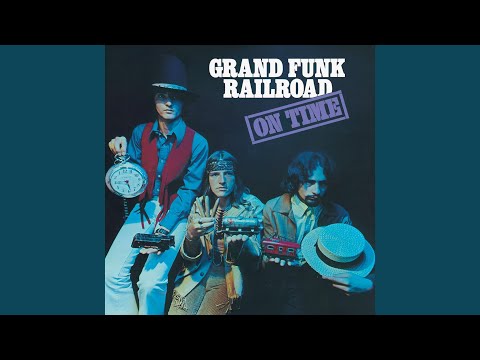
Released in 1969 as part of Grand Funk Railroad's debut album On Time, "Time Machine" announced the arrival of a band that would become one of the most commercially successful and critically polarizing acts of the early 1970s. The track peaked at number 48 on the Billboard Hot 100, a strong showing for a debut single from a group that had formed in Flint, Michigan, just months before the album's release. The song established the essential sonic identity that Grand Funk would carry through their most successful years: a hard rock sound built on massive guitar riffs, propulsive drumming, and a rawness that prioritized visceral impact over studio refinement.
Grand Funk Railroad formed in 1968 from the remnants of a Flint, Michigan, band called Terry Knight and the Pack. The key personnel were guitarist and vocalist Mark Farner, drummer Don Brewer, and bassist Mel Schacher. Terry Knight, who had fronted the original group, transitioned into the role of manager, a move that would prove commercially astute and eventually legally contentious. Knight had connections in the music industry and a clear understanding of how to position the band for maximum exposure. His approach was aggressive and unconventional, and under his management Grand Funk became one of the first rock acts to demonstrate that sustained arena touring could build a massive audience without proportionate critical support.
On Time was recorded quickly and released on Capitol Records in August 1969, just as the American rock landscape was absorbing the reverberations of Woodstock and the explosion of heavy guitar music on both sides of the Atlantic. "Time Machine" was the album's lead single, and its reception demonstrated that there was a substantial audience hungry for music that was heavy, direct, and unambiguous in its energy. The song's production, handled in a style that emphasized volume and clarity of attack over textural complexity, was a deliberate choice that reflected both the band's live performance aesthetic and Knight's commercial instincts.
Mark Farner's guitar work on "Time Machine" established the template for his playing throughout Grand Funk's career: thick, powerful riffs deployed with rhythmic insistence rather than pyrotechnic display. Farner was not a technically baroque guitarist in the manner of contemporaries like Jimmy Page or Duane Allman, but his ability to construct riffs that were immediately memorable and physically compelling was a genuine talent that distinguished him within the hard rock field. Don Brewer's drumming provided the structural foundation for the song's energy, his playing simultaneously aggressive and disciplined in the way that effective heavy rock drumming requires.
The song's chart performance at number 48 was followed by a period of rapidly escalating commercial success that made Grand Funk one of the biggest acts in America by the early 1970s. Their 1971 album Live Album went platinum, and their 1973 recording of "We're an American Band" reached number one on the Hot 100. This trajectory makes "Time Machine" particularly interesting as a historical artifact: it captures the band at their raw beginning, before the production values and arrangements became more sophisticated, before the commercial apparatus around them became enormous, and before the critical backlash intensified into a sustained cultural conversation about what rock music was supposed to mean and who was supposed to be making it.
Capitol Records had signed the band at Knight's urging, and the label's support was essential in getting "Time Machine" the promotional attention it needed to reach the charts. The single's success validated Knight's read on the market and set the commercial logic that would define Grand Funk's early years: albums released in rapid succession, extensive touring, and a direct relationship with a young, largely working-class audience that the band actively cultivated as a point of pride and identity.
The critical reception to Grand Funk in this period was largely negative. Publications like Rolling Stone found the band's music crude and their popularity baffling, a response that the band and their audience tended to wear as a badge of honor rather than absorb as a critique. This dynamic between popular success and critical dismissal became part of Grand Funk's story in ways that made them a useful case study in the sociology of American rock music, but in 1969, with "Time Machine" climbing the charts, those debates were just beginning to take shape.
Mel Schacher's bass playing on the track was a crucial element that sometimes received insufficient attention in discussions of the band's sound. His low-end work gave the music a weight that anchored Farner's guitar and Brewer's drums, creating the three-way interlock that made Grand Funk's live performances so physically overwhelming for audiences of the period. The power trio format, which the band shared with contemporaries like Cream and ZZ Top, demanded that each instrument carry a full share of the sonic load, and "Time Machine" demonstrates the effectiveness with which Grand Funk met that challenge from the very beginning of their recording career.
02 Song Meaning
The Meaning of "Time Machine" by Grand Funk Railroad
"Time Machine" by Grand Funk Railroad is a song that uses the science fiction concept of temporal travel as a vehicle for romantic longing and the desire to escape present circumstances. Released in 1969 from the debut album On Time, the track belongs to a tradition of rock songs that borrowed the vocabulary of speculative fiction to address emotional states that more conventional language might struggle to contain. For a band that prided itself on directness and physical energy, the science fiction framing provided a way to approach emotional material with a degree of imaginative distance.
The central conceit of the song is the wish to move through time, to reach a different moment, whether in the past or the future, where things might be better or different. This is a fundamentally romantic impulse in the philosophical sense: a rejection of the present as insufficient, a belief that time contains somewhere a more adequate version of experience. Mark Farner's vocal delivery treats this wish with the kind of earnest intensity that characterized his work throughout Grand Funk's early career, and the music surrounding him magnifies the emotional urgency of the conceit.
There is also a dimension of escapism in "Time Machine" that connects it to the broader cultural moment of 1969. American society at the end of the decade was under enormous strain; the Vietnam War, the assassinations of Robert Kennedy and Martin Luther King Jr., and the political upheavals of the period had created a pervasive sense of crisis and instability. The fantasy of being able to step out of the present moment and find a different time carried particular resonance for young listeners navigating that environment. Rock music of the period frequently offered versions of this escape, and Grand Funk's contribution was characteristically more visceral and less cerebral than those of more critically acclaimed contemporaries.
The song's musical meaning is also worth considering. Grand Funk Railroad's sound in 1969 was itself a kind of time machine, drawing on the blues rock tradition that had developed in the late 1960s while pushing it toward a heaviness and simplicity that pointed toward what would become heavy metal. The riff-driven architecture of "Time Machine" is forward-looking in retrospect, anticipating production and compositional choices that would define rock music in the decade to come. In this sense, the song's title takes on an inadvertent second meaning: it was a machine that moved the genre forward even as its lyrics wished to move backward or sideways through time.
The band's working-class Michigan identity also informed the song's emotional register. The desire to be somewhere or somewhen other than where one is has particular resonance in communities where economic circumstances constrain options, and Grand Funk's audience responded to the song with the kind of identification that suggested its emotional logic was connecting with something real in their experience. The time machine in this reading is not just a science fiction device but a figure for any form of imaginative escape from the limitations of ordinary life, and the music's raw energy was itself a form of that escape, delivered in real time.
→ More from Grand Funk Railroad
View all Grand Funk Railroad hits →
→ More from the 1960s File
View all 1960s hits →




Keep digging