The 1960s File Feature
Stop! In The Name Of Love
"Stop! In The Name Of Love" — The Supremes at the Height of Their Reign Detroit in Its Golden Hour Imagine standing on a street corner in early 1965, radio i…
01 The Story
"Stop! In The Name Of Love" — The Supremes at the Height of Their Reign
Detroit in Its Golden Hour
Imagine standing on a street corner in early 1965, radio in hand, as the first notes of a new Supremes single crackle through the speaker. The Motown machine was running at full speed that winter, and Diana Ross, Mary Wilson, and Florence Ballard had already delivered hits enough to make them the most commercially successful female vocal group in the history of American pop. The label's creative team, centered on Holland-Dozier-Holland, was producing singles with the precision and regularity of a well-oiled assembly line, and each new Supremes release felt like an event.
Into this climate arrived "Stop! In The Name Of Love," released on Motown Records in February 1965. The single had an immediately recognizable structure: a commanding title phrase, an irresistible melody, and lyrics that laid out a romantic confrontation with clarity and feeling. It was Holland-Dozier-Holland at their practiced best, writing material that understood exactly what the Supremes could do and engineered the song around Diana Ross's cool, precise delivery.
The Holland-Dozier-Holland Blueprint
Brian Holland, Lamont Dozier, and Eddie Holland had developed a distinctive formula for the Supremes' run of hits, and "Stop! In The Name Of Love" represents a high-water mark of their collaboration. The track was written and produced by Holland-Dozier-Holland and recorded at Hitsville U.S.A., Motown's iconic Detroit studio at 2648 West Grand Boulevard. The rhythm section that anchors the track belongs to the Funk Brothers, Motown's in-house studio ensemble whose contributions defined the label's sonic signature throughout the 1960s, even though they rarely received prominent credit at the time.
The arrangement builds around a rhythmic urgency that mirrors the lyric's emotional desperation. Ross pleads from a position of strength rather than weakness: the narrator is not simply heartbroken but actively intervening, demanding that a wandering partner pause and reconsider. That combination of vulnerability and authority gave the song an energy that felt distinctive, less passive than many romantic pop ballads of the era and more confrontational.
A Number One Ascent
The single debuted on the Billboard Hot 100 on February 20, 1965, at position 80, and from there it moved with the kind of momentum that comes from both radio saturation and genuine public enthusiasm. Within two weeks it had reached number 13, then climbed to number 3, then number 2. The track hit number one on the Billboard Hot 100 during the week of March 27, 1965, completing a chart run that spanned twelve weeks in total. That chart peak was the fifth consecutive number one single for the Supremes, a streak that placed them alongside the most dominant acts in the contemporary pop landscape.
The song also performed strongly on the R&B charts, as was typical for Supremes releases during this period, confirming that the group's appeal crossed multiple listener demographics simultaneously. Motown's genius was in crafting material that felt authentic within the Black musical tradition while also radiating broadly enough to dominate mainstream pop radio, and "Stop! In The Name Of Love" exemplified that achievement.
The Choreography Becomes Legend
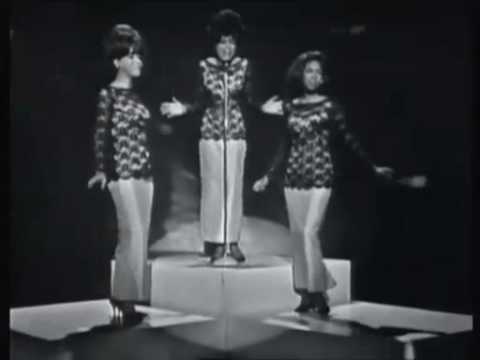
Part of what cemented this particular single in popular memory was its associated stage performance. The outstretched hand gesture that accompanied the title phrase became one of the most recognizable pieces of pop choreography in the 1960s, replicated at school dances and television variety programs across the country. The visual hook reinforced the verbal hook, making the song not merely a listening experience but a performance piece that audiences could participate in, at arm's length, from their living rooms.
The Supremes performed the song on television multiple times during its chart run, and each performance spread the gesture further. This was the kind of organic cultural contagion that preceded the viral mechanics of later decades; it spread through imitation and shared delight rather than algorithmic amplification.
Its Place in the Motown Constellation
The Supremes would continue releasing major hits through the late 1960s, and Diana Ross would go on to a major solo career that extended for decades. "Stop! In The Name Of Love" stands as one of the defining singles of the group's classic period, the moment when everything the Holland-Dozier-Holland partnership had been building toward cohered into a single perfect three-minute argument. Its five-number-one streak demonstrated a commercial dominance that few acts of any era have matched.
Put on the record and let that opening declaration do what it has always done: stop you where you stand.
"Stop! In The Name Of Love" — The Supremes' singular moment on the 1960s charts.
02 Song Meaning
"Stop! In The Name Of Love" — Meaning, Themes, and Cultural Resonance
The Architecture of a Confrontation
On the surface, "Stop! In The Name Of Love" is a song about romantic betrayal. A narrator confronts a partner she suspects of infidelity, asking him to pause and think about what he stands to lose before acting on whatever impulse is pulling him away. The emotional logic of the lyric is direct: if you value what we have built together, consider the consequences before you destroy it. This is not a passive lament but an active intervention, and that distinction matters enormously for understanding why the song connects the way it does.
The appeal to "love" as a commanding force gives the title phrase an almost juridical authority. The narrator invokes love not as a feeling she possesses but as a principle with independent standing, something larger than either partner that both are bound to respect. That rhetorical move elevates the song above simple pop romanticism into something that feels genuinely moral in its stakes.
Female Agency in 1965 Pop
The song's emotional stance was unusual for its era. Much 1960s pop positioned women as recipients of male attention: longing for a call, waiting for a boy to notice them, suffering quietly when a relationship ended. "Stop! In The Name Of Love" reverses this dynamic entirely. Diana Ross's narrator is commanding, self-possessed, and direct. She is not asking; she is demanding. She knows her own worth and states it plainly.
This assertiveness resonated with female listeners who found in the song a form of expression that mainstream pop rarely offered. The Supremes' poise, their polish, and their authority as performers amplified the lyric's message: these were women who expected to be heard and took for granted that they deserved to be. The combination of emotional vulnerability and commanding delivery gave the song a complexity that simpler girl-group material often lacked.
Motown's Crossover Mission
The song also carries the social weight of its production context. Motown Records under Berry Gordy was pursuing a specific and historically significant strategy: to place Black artists at the top of the mainstream pop charts by crafting material that was impeccably produced, emotionally universal, and commercially irresistible. The Supremes were central to that mission, and "Stop! In The Name Of Love" represents its full fruition.
The song reached listeners across racial and regional boundaries in 1965, a moment of intense social upheaval in the United States. The Civil Rights Movement was at a critical juncture, the Voting Rights Act was months away from passage, and American popular culture was one of the arenas in which questions of equality and visibility were being actively contested. A Black vocal trio at the top of the mainstream pop charts, singing about love with authority and grace, was not simply entertainment; it was a kind of argument made through commercial success.
Why the Song Endures
Decades of radio airplay, film placements, and tribute performances have kept the track in continuous circulation. The song has appeared in major films and television productions, each new placement introducing the song to audiences who encounter it for the first time. The choreographed hand gesture has become shorthand for a certain confident assertion, legible even to people who cannot name the song.
The Holland-Dozier-Holland construction is simply airtight. The melody resolves in exactly the way the ear wants it to; the rhythm section drives without overwhelming; the vocal performance sits right at the front of the mix without strain. These elements combine to produce a record that sounds as immediate today as it did in 1965, because the fundamental craft underlying it has not dated.
The emotional situation the lyric describes, a person trying to hold a relationship together by sheer force of feeling, is one that transcends any particular era. That universality, combined with Motown's precise production and the Supremes' incomparable delivery, ensures the song's continued relevance.
→ More from The Supremes
View all The Supremes hits →


→ More from the 1960s File
View all 1960s hits →




Keep digging