The 1960s File Feature
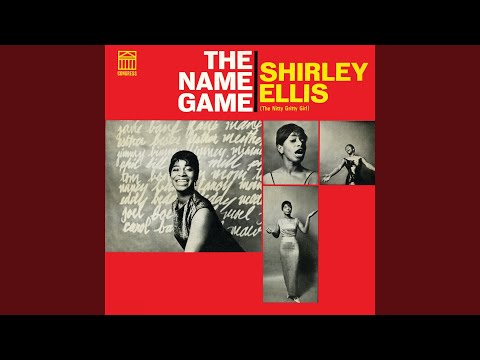
The Name Game
The Name Game — Shirley Ellis and the Art of the Novelty Hit Shirley Ellis recorded "The Name Game" in 1964 for Congress Records , the minor label subsidiary…
01 The Story
The Name Game — Shirley Ellis and the Art of the Novelty Hit
Shirley Ellis recorded "The Name Game" in 1964 for Congress Records, the minor label subsidiary of Kapp Records, and released it to a response that neither the artist nor her label could have fully anticipated. The record rose to number three on the Billboard Hot 100, becoming one of the most successful novelty recordings of the mid-1960s and establishing Ellis as a distinctive voice in the space where pop song met playground chant. The record's success was remarkable for an artist on a small label with limited promotional resources, and it demonstrated that a sufficiently infectious sonic idea could cut through the noise of the mid-1960s pop market on pure viral force.
Ellis had co-written "The Name Game" with Lincoln Chase, her collaborator on the similarly constructed "The Nitty Gritty," which had preceded it on the charts and established the formula. Chase was an experienced songwriter who had contributed to the careers of several artists in the late 1950s and early 1960s, and his collaboration with Ellis was built around the particular novelty concept that her voice and personality were best suited to deliver: songs structured as participatory games, records that invited the listener to perform along rather than simply listen. "The Name Game" was the most successful execution of that concept.
The song's mechanism is a phonemic substitution game applied to names, using a set of rhyme and alliteration rules to transform any name into a funny-sounding phrase. The game itself predates the record, having circulated as a children's playground activity with various regional variants. Ellis and Chase formalized it into a pop song structure, providing specific names as examples while making clear that the game was infinitely repeatable with any name the listener chose to apply. This open-ended participatory quality was the record's key innovation as a commercial product and the primary reason for its extraordinary success.
The production on "The Name Game" was straightforward and percussion-forward, with the rhythm track providing the scaffolding on which Ellis's vocal performance could hang the game's various iterations. Ellis's delivery was a key factor in the record's success; she brought an infectious energy and comedic timing to the performance that made the game feel genuinely fun rather than merely mechanical. The record sounded like something being enjoyed rather than something being performed, and that quality of spontaneous pleasure was difficult to manufacture and comparably difficult to resist.
"The Name Game" reached number three on the Hot 100 in early 1965, following "The Nitty Gritty," which had reached the top ten in 1963. The follow-up success confirmed Ellis as a chart presence rather than a one-hit novelty act, though the specific nature of her appeal made it difficult to sustain commercial momentum beyond the novelty sphere. Congress Records did not have the promotional infrastructure to build on the success, and Ellis's subsequent releases achieved diminishing chart returns despite their consistent quality.
The broader context of novelty songs in the mid-1960s pop market is worth considering. The Hot 100 during this period contained a significant number of records that prioritized comic invention, clever wordplay, or participatory audience engagement over conventional romantic themes. Acts like Allan Sherman, Ray Stevens, and the Chipmunks maintained commercial presences alongside the Beatles and Motown, and records like "The Name Game" occupied a different but equally legitimate space in the pop ecosystem. They served specific social functions, providing shared entertainment experiences that worked particularly well in group settings.
The record's cultural longevity has been notable. "The Name Game" has appeared in film, television, and advertising contexts across multiple decades, most prominently in the television series "American Horror Story: Asylum," where a production number built around the song became one of the more memorable sequences of that series' run. Each new context has introduced the record to a new generation, ensuring that Ellis's 1964 novelty has maintained a presence in popular culture far beyond what its original chart run would have predicted.
Shirley Ellis never achieved a comparable commercial peak following "The Name Game," and her career arc was in some ways characteristic of the novelty hit specialist: a moment of genuine mass attention followed by the difficulty of sustaining an audience that had been attracted by a very specific kind of entertainment. But the record itself endures as a near-perfect example of the participatory novelty song, a self-contained entertainment mechanism that has proven genuinely durable across sixty years of changing popular culture.
02 Song Meaning
Play as Structure: The Meaning of "The Name Game"
"The Name Game" is unusual among hit records because its meaning is almost entirely structural rather than thematic. Most songs communicate through the interaction of melody, harmony, lyrical content, and performance style to produce an emotional or narrative effect on the listener. "The Name Game" does something different: it communicates a set of rules and then invites the listener to operate within those rules, producing meaning through participation rather than through receptive listening. The song is less a statement than a game, and its content is the game itself.
This makes "The Name Game" an interesting case study in what a pop song can be. Shirley Ellis and Lincoln Chase recognized that the pleasure of the phonemic substitution game they encoded in the record was not the pleasure of hearing a finished art object but the pleasure of playing. Each name substituted into the pattern produces a different result, some more amusing than others, and the amusement comes from the unpredictable outcomes of applying consistent rules to variable inputs. The song teaches a game, then steps back and lets the listener play it.
The participatory dimension of "The Name Game" places it in a tradition of folk and children's music that predates recorded sound. Call-and-response songs, round songs, and game songs have existed in human cultures as long as music itself, serving the social function of bringing groups of people into coordinated shared activity. Ellis's record commercialized and amplified this tradition, broadcasting a participatory game over the radio to an audience that could be engaged even through the one-way medium of broadcast.
There is a democratic quality to the game's mechanism that deserves notice. By using the listener's own name as the raw material for the game, the song incorporates the listener into its content in a way that few records manage. Everyone who hears "The Name Game" and tries it with their own name becomes briefly the subject of the song, inserting their own identity into Ellis's framework. This is a form of personalization that predates the algorithmic personalization of streaming by sixty years, and it was achieved with nothing more than a clever set of phonological rules.
The emotional register of the record is straightforwardly playful, and Ellis's performance makes that playfulness feel genuine rather than calculated. There is real delight in her delivery, a quality that communicates that the performer is having fun with the material rather than treating it as a commercial transaction. This authenticity of play is what distinguishes the best novelty records from merely cynical ones; when the performance believes in the game, the listener believes in it too.
The song's persistence in popular culture, through television placements, nostalgia programming, and generational transmission from parents to children, reflects the durability of the underlying game rather than specifically the durability of the 1964 recording. But the recording and the game are effectively inseparable at this point; "The Name Game" as a cultural object is Ellis's version, with its specific tempo, arrangement, and vocal performance providing the framework within which the game is played.
In the context of 1964 pop music, the record represented an assertion that there was space in the commercial mainstream for music that prioritized communal play over individual emotional expression. The Hot 100 in this period could accommodate both the intense romantic yearning of Motown and the participatory silliness of "The Name Game," a breadth of function that reflected the genuine diversity of human needs that popular music has always served. Ellis exploited that breadth with considerable skill, producing a record that asked nothing of its listeners except that they join in.
→ More from Shirley Ellis
View all Shirley Ellis hits →


→ More from the 1960s File
View all 1960s hits →




Keep digging