The 1960s File Feature
The One On The Right Is On The Left
The One On The Right Is On The Left: Johnny Cash's Comic Masterpiece In the mid-1960s, Johnny Cash was one of the most recognizable voices in American popula…
01 The Story
The One On The Right Is On The Left: Johnny Cash's Comic Masterpiece
In the mid-1960s, Johnny Cash was one of the most recognizable voices in American popular music, yet he remained capable of surprising his audience with unexpected tonal shifts. Released in the spring of 1966 on Columbia Records, "The One On The Right Is On The Left" demonstrated that the Man in Black could make the country music faithful laugh as readily as he could make them weep. The song was written by Jack Clement, one of Nashville's most celebrated figures, who had already shaped Cash's career as a producer and collaborator at Sun Records in Memphis during the late 1950s.
Clement's comic gift was on full display with this number. The song's premise involves a folk singing group whose members hold wildly incompatible political views, which creates constant internal strife that threatens to derail every performance. The absurdity builds systematically, with the narrator cataloguing the ideological differences among bandmates and the petty arguments that result. At its core, the track was a gentle but pointed satire of the folk revival's earnest political posturing, arriving at a moment when acts like Peter, Paul and Mary and the broader folk scene were closely identified with progressive causes. Cash, never easily categorized on the political spectrum, delivered Clement's words with the deadpan authority of a man who found ideological rigidity of all varieties slightly ridiculous.
The recording sessions took place at Columbia's Nashville facilities, with the characteristic warmth and directness that defined Cash's studio work of the period. The production kept the arrangement simple and conversational, allowing Cash's baritone and his natural storytelling authority to carry the comedic weight. Don Law and Frank Jones, the producers who oversaw much of Cash's Columbia output during this era, understood that the track required space and restraint rather than elaborate instrumentation.
The single reached number two on the Billboard Hot Country Singles chart, confirming that Cash's country audience embraced the lighter side of his persona just as enthusiastically as his harder-edged material. The track also crossed over to the mainstream pop charts, entering the Billboard Hot 100 and demonstrating once again Cash's ability to transcend genre boundaries. Country comedy records had a long tradition on the charts, but few artists commanded the kind of credibility that allowed a humorous novelty record to feel entirely consistent with a serious artistic identity. Cash managed this balance with characteristic ease.
The timing of the release was commercially astute. 1966 was a period of intense creative output for Cash on Columbia, and placing a comic single into the market helped vary the emotional palette of his catalog while keeping his name on radio playlists between weightier projects. The album "Everybody Loves a Nut," released that same year, collected several of Cash's comic recordings and signaled a deliberate effort to establish humor as a legitimate thread in his artistic identity rather than merely an occasional diversion.
Jack Clement's authorship was an important part of the song's reception. By the mid-1960s, Clement was known across Nashville as a songwriter and producer of uncommon wit and inventiveness. His association with Cash lent the track credibility within the industry, and songwriting credits in country music carried considerable weight with both radio programmers and critics. The fact that Cash had chosen a Clement composition reaffirmed the bond between the two men that had first formed when Clement worked the boards at Sun.
Within Cash's broader discography, the song occupies a singular place. He was not primarily a comic artist, and moments of outright humor in his catalog are relatively rare compared to the gospel gravitas, outlaw mythology, and folk storytelling that dominate his recorded legacy. Yet Cash was by all accounts a genuinely funny man in person, known for elaborate practical jokes and a dry wit that surfaced in interviews and on stage. "The One On The Right Is On The Left" gave that side of his personality permanent form in the studio.
The cultural footprint of the track extended beyond its initial chart run. It was a song that radio programmers could reach for when they wanted to leaven a playlist, and it appeared on numerous compilation packages over the decades as evidence that Cash's range was wider than his somber image might suggest. It introduced younger listeners to the idea that country music could accommodate irony and self-aware comedy alongside its more earnest traditions, a lesson that would prove influential in subsequent generations of country songwriting.
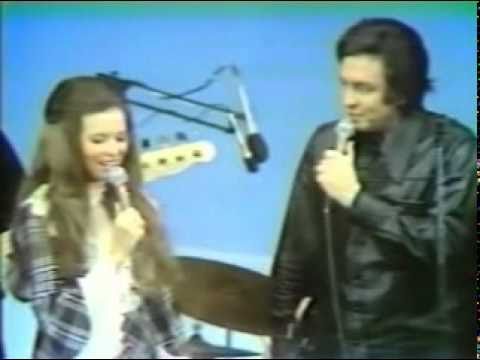
Cash performed the song on his television variety program, "The Johnny Cash Show," which aired on ABC from 1969 to 1971, bringing the track to an even wider audience. The television platform amplified the comedic element, allowing Cash's facial expressions and timing to add a visual layer to Clement's already effective writing. Audiences who knew Cash primarily as the brooding artist of the "Ring of Fire" era found the performance genuinely surprising and charming.
Decades after its release, the song remains one of the more frequently cited examples of Cash's comic range. It appears on career retrospectives and has been discussed in biographies and critical studies as evidence that the Man in Black was, at his core, a full-dimensional human being whose artistic identity could not be reduced to a single emotional register. Jack Clement's sharp writing and Cash's impeccable delivery ensured that what might have been a throwaway novelty record became instead a durable and genuinely funny piece of American popular music.
02 Song Meaning
Laughing at the Folk Singers: What The One On The Right Is On The Left Means
"The One On The Right Is On The Left" works on several levels simultaneously, which is part of what makes it endure as more than a simple novelty. On the surface, it is a comic portrait of an imaginary folk group whose members hold irreconcilable political beliefs. The narrator describes a band where right-wing views sit directly beside left-wing ones, where moderates argue with radicals, and where the constant ideological bickering makes it nearly impossible to get through a single performance without a fight. Jack Clement's writing targets the folk revival's reputation for high political seriousness by imagining what would happen if a group with those pretensions actually had to share a stage while holding contradictory convictions.
The comic premise is elegant because it does not pick a side. The humor is not directed at any single political position but rather at the absurdity of political posturing in general, particularly when it is attached to commercial entertainment. The folk groups of the early to mid-1960s presented themselves as voices of social conscience, and their audiences expected a degree of ideological coherence. Clement's song deflates that expectation by imagining the messy human reality beneath the polished surface of collective artistic endeavor.
Cash's delivery is crucial to the meaning of the piece. He performs the song with an absolutely straight face, narrating the group's dysfunction with the calm authority of a man reading a news report. This deadpan quality is what transforms a clever comic premise into something genuinely funny. If Cash had signaled the joke too heavily, the track would have felt condescending. Instead, his measured tone treats the absurdity with a kind of bemused journalistic seriousness that amplifies the comic effect.
The song also carries a subtle commentary on artistic compromise and the difficulty of maintaining group identity under pressure. The fictional folk group's inability to agree on anything reflects a broader truth about collaborative creative endeavors, where individual personalities and beliefs can pull against the shared project. In this reading, the song is not only about politics but about the inherent tensions within any ensemble, the question of how people with different values manage to make something together.
For Cash's catalog, the track represents an important reminder that his public image as a figure of darkness and moral weight was always a partial picture. Cash was a multifaceted performer, and his willingness to record and champion comic material indicated an artistic self-confidence that did not require constant seriousness to sustain credibility. The song exists in productive tension with tracks like "Man in Black" and "Folsom Prison Blues," not undermining them but rather adding depth to the portrait of a complex artist.
The political satire embedded in the lyrics was mild enough to avoid genuine controversy while sharp enough to feel pointed. The mid-1960s was a period of profound political tension in the United States, with civil rights struggles, Vietnam War protests, and generational conflict all creating an atmosphere in which political positions carried serious moral weight. To laugh gently at political earnestness in that climate required a certain confidence, and Cash and Clement demonstrated that confidence by keeping the tone light and the targets non-specific.
Audiences understood the song as an invitation to step back from ideological seriousness for a moment and appreciate the fundamental comedy of human disagreement. That is a mode of social commentary with deep roots in American popular culture, from the political cartoonists of the nineteenth century through the radio comedians of the mid-twentieth. Cash placed himself in that tradition with this recording, suggesting that laughter could be a form of wisdom as well as entertainment.
The lasting emotional resonance of the track lies in its universality. The specific target of the folk revival was topical in 1966, but the broader observation about groups being undone by internal disagreement has remained relevant across every subsequent decade. The song's comic energy translates readily to any contemporary situation in which earnest political performers find themselves at odds with one another, which is to say, it translates readily to almost every era.
→ More from Johnny Cash
View all Johnny Cash hits →

→ More from the 1960s File
View all 1960s hits →




Keep digging