The 1960s File Feature
Release Me (And Let Me Love Again)
Release Me: Engelbert Humperdinck and the Song That Stopped Beatlemania The story of "Release Me (And Let Me Love Again)" as performed by Engelbert Humperdin…
01 The Story
Release Me: Engelbert Humperdinck and the Song That Stopped Beatlemania
The story of "Release Me (And Let Me Love Again)" as performed by Engelbert Humperdinck is, in many respects, a story about the unpredictability of popular taste at a particular cultural inflection point. In January 1967, the British pop landscape was dominated by the Beatles, whose cultural authority seemed almost absolute. Yet when Humperdinck released "Release Me" in February of that year, it climbed to number one on the UK Singles Chart and remained there for six consecutive weeks — preventing the Beatles' double A-side "Penny Lane" and "Strawberry Fields Forever" from reaching the top position. It is one of the most famous instances of chart displacement in pop history. In the United States, the song reached number 4 on the Billboard Hot 100, spending fourteen weeks on the chart and establishing Humperdinck as a major international star.
The song's origins predate Humperdinck's version by more than a decade. "Release Me" was written in the early 1950s by Eddie Miller and W.S. Stevenson, with additional songwriting credits attributed to Robert Yount in some versions. It was initially recorded as a country song, and numerous country artists cut versions throughout the 1950s. Ray Price recorded a notable version in 1954. Esther Phillips released a version in 1962 that reached number eight on the Billboard Hot 100, introducing the song to a broader pop audience. But it was Humperdinck's 1967 recording that transformed the song into a vehicle for sustained international stardom.
Engelbert Humperdinck was born Arnold George Dorsey in Madras, India, in 1936, to a British father serving in the military. The family relocated to Leicester, England, where Dorsey grew up and began pursuing a singing career in the late 1950s under his birth name. His early career stalled, and by the mid-1960s he was performing in modest venues with limited commercial success. His fortunes changed dramatically when he came under the management of Gordon Mills, the same manager who oversaw Tom Jones. Mills suggested the stage name Engelbert Humperdinck — borrowed from the nineteenth-century German opera composer — as a means of creating an identity that was simultaneously memorable and slightly absurd in its grandeur.
The recording of "Release Me" was produced by Charles Blackwell and arranged to maximize the emotional weight of Humperdinck's baritone. The production is lush without being overblown, providing a sympathetic frame for the singer's voice without overwhelming it. Humperdinck's delivery is controlled and warm, projecting a sincerity that makes the narrator's request for release feel genuinely affecting rather than merely theatrical. The arrangement draws on the easy listening and adult contemporary traditions that were undergoing a commercial revival in the mid-1960s as the pop mainstream expanded to accommodate both the British Invasion and its predecessors.
The song's success in Britain was partly attributable to timing and partly to a genuine appetite among British audiences for a more traditional approach to popular song alongside the increasingly experimental work being produced by the Beatles, the Rolling Stones, and their peers. The easy listening market was substantial and underserved by the dominant youth-oriented sounds of 1966 and 1967, and Humperdinck — handsome, polished, and possessed of a genuinely impressive voice , offered an alternative that resonated with audiences who felt left behind by the psychedelic turn in mainstream pop.
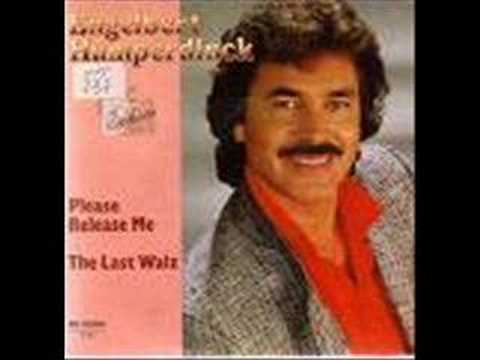
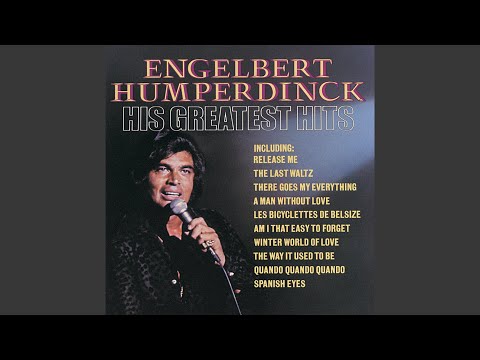
American success followed naturally from the UK breakthrough. Parrot Records released the single in the United States, and it entered the Hot 100 in the spring of 1967, climbing to its peak of number 4. Humperdinck became a fixture on American television variety programs, and his subsequent singles maintained his commercial profile throughout the late 1960s. "There Goes My Everything" reached number 20 in 1967, and "The Last Waltz" hit number 25 in 1967 as well, confirming that his success was not a fluke but the foundation of a durable career.
Humperdinck continued recording and performing into the twenty-first century, remaining a popular live attraction particularly in the United States, the United Kingdom, and Southeast Asia. His longevity as a performer speaks to the depth of the emotional connection he established with audiences in 1967. "Release Me" remains his signature recording and one of the most commercially successful easy listening records of the 1960s, a song that demonstrated the ongoing vitality of traditional pop craftsmanship even at the height of the rock revolution.
02 Song Meaning
The Grammar of Farewell: Understanding "Release Me (And Let Me Love Again)"
"Release Me (And Let Me Love Again)" is a song about the dissolution of a marriage told from the perspective of someone who has fallen in love with another person and can no longer pretend otherwise. Its emotional architecture is built on a tension that the song never fully resolves: the narrator wants release from obligation, but the song's sympathetic framing asks the listener to understand that request as something other than simple selfishness. Whether it succeeds in that argument is, in part, what makes the song so persistently interesting as a piece of popular songwriting.
The narrator addresses a spouse directly, acknowledging that there is no future for their relationship and asking to be freed from it honorably rather than destroyed by its continuation. The framing is polite, even tender, which is one of the song's most strategically interesting choices. A crueler song would frame the same narrative from the abandoned partner's perspective. "Release Me" insists on the leaving partner's point of view and asks the listener to find it legitimate. The fact that the song became a massive international hit suggests that enormous numbers of people found that perspective recognizable and even sympathetic.
This is partly a function of the song's country music origins. Country songwriting has always engaged seriously with the moral complexity of romantic failure, treating infidelity and the dissolution of marriages as genuinely tragic rather than merely scandalous. The country tradition from which "Release Me" emerged in the early 1950s understood that people leave marriages for reasons that are not always reducible to villainy, and that the desire for a new love is a human response to human circumstances. Engelbert Humperdinck's recording preserved that moral seriousness even while translating the song into the easy listening idiom of 1960s British pop.
The title phrase itself is carefully constructed. "Release me" is a passive construction — it asks to be let go rather than claiming the right to leave unilaterally. The addition of "and let me love again" makes explicit that the narrator's motivation is not freedom from commitment in general but the specific desire to love a particular other person. This specificity matters: the narrator is not running away from love but toward it, which complicates any simple moral judgment about the act of leaving.
The song's enormous commercial success in Britain in 1967 — six weeks at number one, blocking the Beatles at the height of their cultural dominance — reflects something real about the emotional landscape of its audience. Pop music in 1967 was increasingly experimental and youth-oriented, but large numbers of people wanted music that spoke to adult emotional experience in a direct and accessible way. Marriage, fidelity, and the desire to leave were subjects that resonated with a generation of adults navigating relationships in a rapidly changing social environment.
In retrospect, the song sits at an interesting cultural threshold. The late 1960s would see dramatic changes in attitudes toward marriage and divorce in both Britain and the United States, with legal reforms and shifting social norms making the dissolution of marriages easier and less stigmatized. "Release Me" appeared just before those changes fully took hold, speaking to people for whom the desire to leave a marriage still carried enormous weight precisely because it was so difficult and so consequential. The song's emotional gravity is inseparable from that historical context.
Humperdinck's vocal performance is central to the song's thematic effectiveness. His baritone carries a warmth that prevents the narrator from sounding cold or calculating, and his phrasing communicates genuine regret alongside the request for release. The result is a performance that makes the listener believe in the narrator's sincerity, which is the prerequisite for the song's emotional logic to function at all.
→ More from Engelbert Humperdinck
View all Engelbert Humperdinck hits →


→ More from the 1960s File
View all 1960s hits →




Keep digging