The 1960s File Feature
Pushin' Too Hard
Pushin' Too Hard: The Seeds and the Raw Engine of Garage Rock In the mid-1960s, the American garage rock scene produced hundreds of singles by regional bands…
01 The Story
Pushin' Too Hard: The Seeds and the Raw Engine of Garage Rock
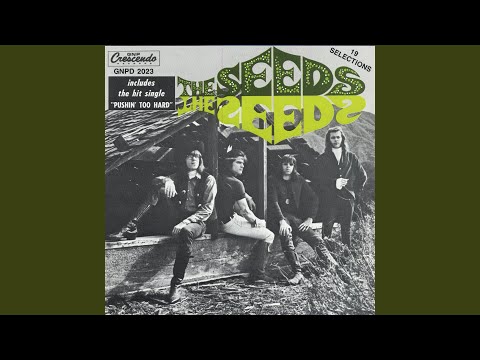
In the mid-1960s, the American garage rock scene produced hundreds of singles by regional bands who blended British Invasion influence with American teenage frustration into recordings of varying quality and lasting cultural significance. Among these, a handful achieved genuine importance as both commercial artifacts and foundational documents of what would eventually be recognized as proto-punk, proto-new-wave, and the full range of aggressive minimalist rock that defined subsequent underground music. "Pushin' Too Hard" by the Seeds, released in 1966 on GNP Crescendo Records, stands as one of the most essential of these recordings, a track whose raw simplicity and emotional directness anticipated the aesthetics of punk rock by a full decade.
The Seeds were a Los Angeles band formed around vocalist and principal songwriter Sky Saxon, born Richard Elvern Andersen, whose theatrical instincts and genuine charisma gave the group a presence that many of their garage-rock contemporaries lacked. The band's lineup included Jan Savage on guitar, Daryl Hooper on keyboards, and Rick Andridge on drums, with Saxon as the defining presence. Their sound was built on a deliberately minimal architecture: the Farfisa organ that Hooper played gave them their most distinctive sonic element, a nasal, slightly adenoidal electronic sound that was immediately identifiable and completely of a piece with the aesthetic they were developing.
"Pushin' Too Hard" was originally recorded in 1965 and released as a single before appearing on the debut album, also titled The Seeds, in 1966. The song reached number 36 on the Billboard Hot 100 in its initial chart run, a respectable showing for a regional band on an independent label without major-label distribution infrastructure. The chart performance, however, underrepresented the song's actual cultural impact, which was felt more through its influence on subsequent musicians and its status as a canonical garage-rock document than through its immediate commercial metrics.
The production of "Pushin' Too Hard" was exactly right for the material, capturing the rawness of the band's approach without polishing it into something more palatable and less honest. The recording has a live quality, a sense that what was captured was a performance in progress rather than a carefully assembled studio artifact, and this quality was responsible for much of its energy and staying power. Many garage-rock recordings of the period suffered from being cleaned up for radio consumption in ways that drained them of the quality that made them interesting; "Pushin' Too Hard" survived without that intervention.
Saxon's vocal performance was central to the track's impact. His voice had a quality of genuine urgency, even desperation, that was different from the more polished rock vocal styles of the period. Where many of his contemporaries were working within the melodic frameworks established by British Invasion acts, Saxon's delivery was rawer, more insistent, and more threatening in its emotional pitch. The combination of Saxon's vocal delivery and the Farfisa organ's distinctive timbre created a sound that was immediately identifiable and that influenced subsequent generations of musicians seeking to capture a similar quality of aggressive emotional immediacy.
The song's lyrical content, which addresses the condition of being pushed past the limits of one's patience and tolerance, connected with the frustrations of the teenage and young adult audience that the garage-rock movement was speaking to. The mid-1960s generation of American young people was navigating a period of profound social and political upheaval, and music that expressed frustration and resistance, even in relatively inarticulate or direct forms, found a ready audience. "Pushin' Too Hard" was not explicitly political, but its emotional register was entirely appropriate to a moment of social pressure and generational conflict.
The critical reassessment of 1960s garage rock that began in earnest in the 1970s, partly driven by punk rock's explicit invocation of the garage aesthetic as an alternative to the excess and pretension of mainstream rock, placed "Pushin' Too Hard" in an increasingly prominent position within the canon. Lenny Kaye's landmark Nuggets compilation of 1972, which assembled the canonical garage-rock singles of the mid-1960s into a single influential collection, included the Seeds among the acts represented and helped establish the historical frame through which "Pushin' Too Hard" has subsequently been understood. The song became a standard reference point for anyone seeking to understand the lineage of aggressive, minimalist rock.
Subsequent cover versions and reappearances of the original in film, television, and advertising contexts have kept "Pushin' Too Hard" accessible to generations of listeners who did not encounter it in its original commercial context. Its presence in the garage-rock canon is by now entirely secure, and its influence on punk, new wave, and the various underground rock traditions that followed is widely acknowledged by artists and critics who have thought seriously about the history of rock music's more abrasive possibilities.
02 Song Meaning
Pushin' Too Hard: Frustration, Resistance, and the Grammar of Garage Rock
"Pushin' Too Hard" is a song about being pushed past the limit of what one is willing to accept, about reaching a point where the pressure of external demands or expectations produces a refusal that is as much physical as rational. Sky Saxon gave the narrator a voice of genuine anger rather than theatrical rebellion, and the distinction matters: this is not the performed outrage of a calculated commercial product but something that sounds like actual impatience reaching the point of eruption. That quality of genuine emotional emergency, however it was achieved in the recording studio, is what gives the song its lasting power and its influence on subsequent artists seeking to capture the same quality.
The specific object of the frustration in "Pushin' Too Hard" is somewhat ambiguous, which is part of the song's strength. The pushing could come from a romantic partner, from authority figures, from social expectations, from the accumulated pressure of a world that demands conformity. This ambiguity makes the song available for multiple kinds of identification, which is why it has functioned effectively across such a wide range of contexts and listening situations. The emotional experience the song describes, of having reached one's limit, is universal in a way that very specific grievance narratives are not, and the song exploits that universality without losing the sense of genuine personal urgency that makes the emotional content credible.
The garage-rock aesthetic that "Pushin' Too Hard" exemplifies carried a specific kind of meaning in the mid-1960s. At a moment when mainstream rock was becoming increasingly sophisticated in its production values, when the Beatles and their successors were pioneering studio techniques of considerable complexity, the garage-rock bands were asserting the value of rawness, of limited means, of a confrontational directness that elaborate production might have diluted. The Farfisa organ sound and the minimal arrangement of "Pushin' Too Hard" were not merely what the Seeds could afford; they were a kind of aesthetic declaration, an assertion that emotional truth mattered more than sonic sophistication.
For the proto-punk lineage that "Pushin' Too Hard" helped establish, the song carried meaning as proof that aggressive minimalism could be commercially viable and artistically significant. When the Ramones, the Stooges, and other first-wave punk and proto-punk acts were developing their approaches in the early-to-mid 1970s, they were drawing on a tradition that "Pushin' Too Hard" had helped create, a tradition that valued economy, directness, and emotional immediacy above musical complexity or production polish. The Seeds' influence on Iggy Pop and the Stooges in particular has been acknowledged, and through the Stooges, the Seeds' aesthetic reached an entire subsequent generation of underground rock.
Saxon's persona as a performer also contributed to the song's meaning. His presentation as a genuine outsider, someone who did not fit comfortably within the commercial mainstream of the music industry, gave "Pushin' Too Hard" an extra dimension of autobiographical credibility. The refusal to be pushed too hard was not just a lyrical position but an existential one, a description of how Saxon and by extension the Seeds related to the music business and to the social world more broadly. This alignment between the performer's known identity and the song's emotional content is one of the factors that has made the recording feel authentic across decades of recontextualization.
The meaning of "Pushin' Too Hard" for listeners in the twenty-first century is partly historical, a document of a specific moment in the development of rock music, and partly immediate, a record of a feeling that does not age. Its presence in contemporary streaming playlists alongside contemporary punk, indie, and garage-revival music demonstrates that the emotional logic of the song remains legible and relevant far outside its original historical context. The grammar of refusal and resistance that "Pushin' Too Hard" helped establish is still the grammar of a significant strand of rock music, and the song remains one of its earliest and most forceful expressions.
→ More from The Seeds
View all The Seeds hits →
→ More from the 1960s File
View all 1960s hits →




Keep digging