The 1960s File Feature
Mr. Spaceman
"Mr. Spaceman" — The Byrds Take Country-Rock to the Cosmos Folk-Rock Graduates to Something Stranger By the autumn of 1966, the Byrds had already accomplishe…
01 The Story
"Mr. Spaceman" — The Byrds Take Country-Rock to the Cosmos
Folk-Rock Graduates to Something Stranger
By the autumn of 1966, the Byrds had already accomplished something remarkable: they had taken Bob Dylan's acoustic poetry, electrified it, and helped invent folk-rock. They had introduced the twelve-string Rickenbacker jangle to a generation of listeners who would spend years trying to replicate it. They had a number one hit in their rearview mirror with "Mr. Tambourine Man." What they did not yet have was a direction for whatever came next. "Mr. Spaceman" turned out to be one of the most intriguing signposts on that journey, a track that pointed simultaneously toward humor, science fiction, and the country music that would soon reshape their entire artistic identity.
Written by Roger McGuinn, the song arrived as the Byrds were navigating the mid-1960s explosion of psychedelic experimentation in rock while also developing an interest in country music that would eventually produce Sweetheart of the Rodeo in 1968. "Mr. Spaceman" sits in the gap between those two impulses, too playful for pure psychedelia and too cosmic for traditional country, occupying an eccentric middle territory that was entirely its own.
The Sound of the Track
The production of "Mr. Spaceman" is notable for its lightness. Where much of the Byrds' work had a shimmer and density rooted in their folk-rock foundations, this track moved with a kind of loose, almost country-inflected bounce. The bass line had a loping quality, the drumming was relaxed rather than driven, and the guitar work incorporated elements of what would soon be recognizable as country-rock. McGuinn's vocal harmonies with David Crosby and Chris Hillman gave the song the layered vocal texture that was the Byrds' signature sonic contribution to 1960s rock, but the arrangement overall felt more spacious and open than their earlier work.
The lyrical conceit involved a narrator addressing visitors from another world, inviting alien beings to take him away from the routine of earthly existence. The tone was warmly comic rather than anxious, treating the subject matter with an affection that reflected the countercultural moment's genuine openness to alternative realities and unconventional perspectives. This was not the science fiction of cold war paranoia but the science fiction of curious, enthused exploration.
Charting Through the Fall of 1966
"Mr. Spaceman" debuted on the Billboard Hot 100 on September 24, 1966, at position 90. Over the following weeks it climbed steadily, passing through positions 69, 56, 43, and 38 before reaching its peak of number 36 on October 29, 1966. The single spent seven weeks on the Hot 100, a moderate run that reflected the Byrds' consistent commercial presence during their peak period even if the track did not approach the chart heights of their earlier singles.
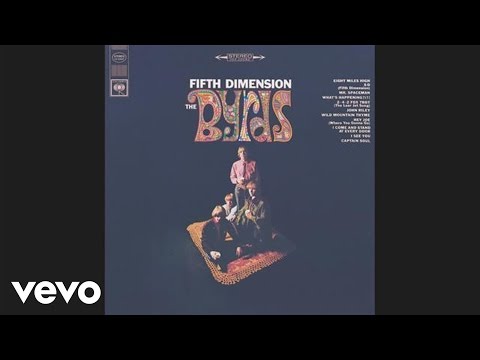
The song appeared on their third studio album, Fifth Dimension, a record that marked a significant shift in the band's sound away from the pure folk-rock of their debut toward something more experimental and eclectic. The album's title track had gestured toward jazz and avant-garde influences; "Mr. Spaceman" offered a more accessible, gently comic contrast within that broader exploratory framework.
1966 and the Expanding Universe of Rock
The autumn of 1966 was a particularly fertile moment for rock music. The Beatles had released Revolver that summer, effectively redrawing the boundaries of what rock records could attempt. The Beach Boys' Pet Sounds had arrived earlier in the year, expanding the harmonic and production ambitions of the format. In this environment, a band like the Byrds could take a song about communicating with extraterrestrials and have it treated as a legitimate pop single rather than a novelty curiosity.
That openness in the musical culture of 1966 is essential context for understanding how "Mr. Spaceman" was received. The song's whimsy was not an aberration in that landscape; it fit naturally into a year when rock musicians were expanding in every conceivable direction simultaneously, testing the limits of what listeners would accept from artists they trusted.
A Pointer Toward Country-Rock's Future
In retrospect, "Mr. Spaceman" is most interesting as a transitional document. The track's country-inflected rhythmic sensibility and its relaxed, open production point directly toward the direction the Byrds would pursue in 1968, when they embraced country music fully on Sweetheart of the Rodeo and helped invent a new genre in the process. Heard in that context, the song is less a detour into science fiction novelty and more an early experiment in the sonic vocabulary that would define their most historically significant work.
Put it on and hear what the Byrds sounded like in the moment between what they had been and what they were becoming. The transition was comfortable enough to be funny and substantial enough to matter.
"Mr. Spaceman" — The Byrds' singular moment on the 1960s charts.
02 Song Meaning
"Mr. Spaceman" — Cosmic Escape and Gentle Longing
The Desire to Be Taken Away
At its most direct level, "Mr. Spaceman" is a song about wanting out. The narrator addresses an extraterrestrial presence, inviting contact and asking to be transported somewhere beyond the ordinary. The tone is light and warm, but the underlying feeling is recognizable: the sense that everyday existence has become too small, too predictable, too enclosed, and that liberation would need to come from somewhere entirely outside the normal order of things.
This desire for escape through extraordinary means is one of pop music's perennial subjects, appearing in different guises across genres and decades. The Byrds gave it a particularly open-hearted expression, one that felt more like playful optimism than desperation. The song's narrator is not fleeing in panic but extending an invitation, which gives the lyrical scenario a quality of agency that distinguishes it from more passive fantasies of escape.
Science Fiction and 1960s Countercultural Imagination
The mid-1960s saw a significant intersection between the countercultural imagination and science fiction imagery. The space race was in full swing, making actual space travel a live and immediate cultural concern rather than a purely speculative one. At the same time, the countercultural movement was exploring alternative realities, altered states of consciousness, and non-conventional frameworks for understanding the world. The alien contact scenario of "Mr. Spaceman" fit naturally into this cultural environment, playing on genuine popular interest in the possibility of other intelligences while reflecting the era's enthusiasm for unconventional experience.
Unlike the science fiction horror that had dominated the previous decade, the 1960s version of extraterrestrial encounter tended toward the benevolent and the transformative. Meeting beings from another world was something to be hoped for, an expansion of experience rather than a threat to be repelled. The Byrds' treatment of the theme reflected this more optimistic register.
Humor as a Philosophical Tool
One of the most interesting qualities of "Mr. Spaceman" is its commitment to a comic tone while engaging seriously with the ideas underneath the humor. The song does not invite the listener to dismiss the longing it expresses simply because the expression is funny. The lightness of delivery is the vehicle for genuine feeling, not a way of avoiding it.
This balance between humor and sincerity is a characteristic feature of the best Byrds material. Roger McGuinn and his collaborators had the ability to be genuinely amusing without becoming novelty acts, to treat cosmic subjects with an affection that was also slightly absurdist without losing the emotional core of the material. "Mr. Spaceman" is a particularly clean example of that balance, a song that makes you smile and then keeps you thinking.
The Country Undercurrent and What It Reveals
The track's rhythmic feel, looser and more country-inflected than much of the Byrds' earlier work, reveals something important about the band's creative thinking in 1966. They were beginning to understand that country music and cosmic speculation were not incompatible, that the wide-open sonic spaces of country could accommodate lyrical content as unconventional as alien contact narratives. This intuition would develop over the following two years into one of the most significant stylistic innovations in American rock music.
Heard from that perspective, the song's meaning extends beyond its immediate lyrical content. It documents a band's imagination expanding to encompass new territory, their willingness to follow an instinct about where their music could go even when that instinct led somewhere as unexpected as a country-flavored song about space travel. That kind of creative curiosity is what separates the artists who matter from those who merely perform.
→ More from The Byrds
View all The Byrds hits →
→ More from the 1960s File
View all 1960s hits →




Keep digging