The 1960s File Feature
Expecting To Fly
"Expecting To Fly" — Buffalo Springfield Neil Young and the Making of a Singular Track There is a particular quality to certain recordings that sets them apa…
01 The Story
"Expecting To Fly" — Buffalo Springfield
Neil Young and the Making of a Singular Track
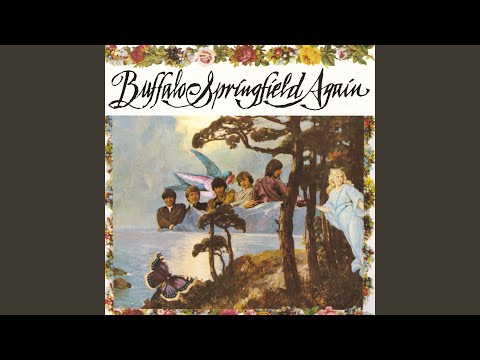
There is a particular quality to certain recordings that sets them apart the moment they begin: a sense of being pulled into a different emotional space, one with its own internal weather and gravity. "Expecting To Fly" has that quality. It appeared at the beginning of 1968 on Buffalo Springfield Again, the second album from one of rock's most volatile and creatively combustible groups, and it stands today as one of the most distinctive recordings of that era: orchestral, introspective, and unmistakably shaped by a singular artistic vision.
"Expecting To Fly" was written and produced by Neil Young, who was at this point still in his early twenties and already demonstrating the uncompromising creative instincts that would define his entire subsequent career. Within Buffalo Springfield, Young occupied a complicated position. He was not the group's primary commercial face, Stephen Stills occupied that role to a considerable degree, but his contributions were consistently among the most artistically distinctive in the catalog. "Expecting To Fly" is the fullest early expression of what his solo work would eventually become.
An Orchestral Vision in a Rock Context
The production of "Expecting To Fly" is unlike anything else in the Buffalo Springfield catalog. Young brought in string and brass arrangements that give the track a lush, almost cinematic quality, creating a soundscape that sits between the folk-rock tradition the group had emerged from and the more orchestrally ambitious work that artists like Brian Wilson and Phil Spector had pioneered earlier in the decade. The result is something genuinely new: a rock song with the emotional register and sonic architecture of a chamber piece.
The orchestration unfolds slowly, giving the strings and horns space to breathe while Young's voice carries the melody with a characteristic fragility. His vocal delivery on this track is restrained almost to the point of disappearing into the arrangement, which creates a haunting quality, as if the narrator is barely present, as if the feeling itself is more substantial than the person experiencing it. The production reinforces this sense: the orchestral elements seem to surround and dwarf the human voice, making the personal feel cosmic.
Chart Life and Commercial Context
The Billboard Hot 100 history of "Expecting To Fly" is notably brief. The record debuted at number 99 on January 13, 1968, and managed only one additional week, climbing to its peak of 98 on January 20, 1968 before departing the chart entirely. Two weeks and a peak of 98 represent the minimum viable chart presence, hardly a commercial story at all.
The modest performance reflected several realities of the moment. Buffalo Springfield as a group was in increasing internal disarray, with lineup changes and interpersonal conflicts that disrupted their promotional activities. More broadly, the track's orchestral ambition and emotional distance from rock convention meant it did not fit easily into radio formats that were still oriented toward more energetic sounds. The record was not built for radio of the moment; it was built for a more attentive kind of listening.
Buffalo Springfield at the Breaking Point
By the time Buffalo Springfield Again was released in late 1967 and "Expecting To Fly" charted briefly in January 1968, the group was approaching its end. The creative tensions between Young and Stills, combined with logistical complications involving personnel and touring, had made the group's continued existence genuinely uncertain. The album itself reflects those tensions: it is brilliant and fragmented, with each major contributor pulling in different creative directions.
In retrospect, the dissolution of Buffalo Springfield was one of the more productive breakups in rock history. The members went on to form or join groups that shaped the sound of the late 1960s and early 1970s: Crosby, Stills, Nash and Young and their various configurations, and Young's solo career that would produce some of the most important recordings in rock history. "Expecting To Fly" feels like a preview of that solo career, the first extended public glimpse of where Young's vision was headed when left to develop without collaborative compromise.
A Record That Found Its Audience Over Time
Two weeks on the Hot 100 is a negligible commercial footprint. But the measure of a recording is not only its initial reception. "Expecting To Fly" has accumulated listeners and admirers over the decades as people have discovered or rediscovered the Buffalo Springfield catalog, often working backward from Neil Young's solo work to find what his earliest experiments sounded like. What they find in this record is something fully formed and remarkably assured for work created by someone still in his early twenties.
Put it on in a quiet room and give it the attention it was built for. You will hear why, despite those chart numbers, it has outlasted the recordings that outsold it by many multiples.
"Expecting To Fly" — Buffalo Springfield's singular moment on the 1960s charts.
02 Song Meaning
"Expecting To Fly" — Longing, Loss, and the Unattainable
The Emotional Register of Reaching
The title of "Expecting To Fly" does much of the interpretive work even before the music begins. To expect to fly is to anticipate something liberating, something transcendent, a release from the weight of ordinary conditions. And yet the title also contains a quiet irony: expecting is not the same as achieving. The reaching is inherent in the title; the arrival is conspicuously absent. This tension between longing and fulfillment runs through the entire track, giving it an emotional texture that rewards repeated listening.
Neil Young writes from a position of suspension, of being caught between what is felt and what is possible. The lyric's images suggest flight and freedom while the music's slow, weighty orchestration pulls in the opposite direction, toward gravity, toward earth, toward the weight of feeling that cannot be shed through sheer desire. That counterpoint between lyrical aspiration and musical weight is the track's central artistic strategy.
Romantic Loss and Its Cosmic Dimension
Young's lyrics, particularly in this early period of his career, tended to dissolve the boundary between personal and cosmic feeling. A love lost in "Expecting To Fly" does not remain merely a love lost; it becomes something larger, a metaphor for the human condition of reaching toward what cannot be held. The orchestral production amplifies this tendency, giving the personal feeling the sonic scale of something universal rather than merely individual.
This tendency to cosmicize personal feeling was one of the defining characteristics of late 1960s rock at its most ambitious. Where earlier rock and roll had stayed close to immediate, physical experience, the new seriousness of the era invited artists to use personal feeling as a window onto larger truths. Young was among the most gifted practitioners of this approach, and "Expecting To Fly" is an early demonstration of his ability to make the intimate feel vast.
Vulnerability as Artistic Strength
The vocal performance on "Expecting To Fly" is notably fragile even by Neil Young's standards. His voice, which always carries a quality of delicate exposure, seems particularly exposed here against the grandeur of the orchestral arrangement. This contrast is not accidental: the vulnerability of the voice against the scale of the strings enacts the emotional premise of the lyric, the small human reaching toward something overwhelmingly larger than itself.
In 1968, this kind of exposed vulnerability in a rock vocal was still unusual enough to register as distinctive. The prevailing models of rock masculinity did not typically feature this quality of fragility in performance, and Young's willingness to inhabit it fully was itself a significant artistic statement. It pointed toward a tradition of sensitive, introspective rock that would become increasingly important through the 1970s.
The Passing of Youth and the Weight of Experience
Reading "Expecting To Fly" in retrospect, knowing what the subsequent decades of Young's career would bring, there is something poignant in its particular quality of youthful longing. The song was created by someone in his early twenties for whom everything still seemed possible and everything still had the potential to hurt with maximum intensity. That combination of openness and vulnerability is a quality particular to early adulthood, and the track captures it with unusual precision.
The record asks its listeners to sit with longing rather than resolve it, to find something valuable in the experience of reaching rather than in the achievement of arrival. That invitation has drawn listeners across more than five decades, each generation finding in it something that matches their own experience of wanting more than circumstances will deliver.
"Expecting To Fly" — Buffalo Springfield's singular moment on the 1960s charts.
→ More from Buffalo Springfield
View all Buffalo Springfield hits →
→ More from the 1960s File
View all 1960s hits →




Keep digging