The 1960s File Feature
Bluebird
Bluebird — Buffalo Springfield California in Ferment The summer of 1967 was supposed to be the Summer of Love, and in San Francisco's Haight-Ashbury district…
01 The Story
Bluebird — Buffalo Springfield
California in Ferment
The summer of 1967 was supposed to be the Summer of Love, and in San Francisco's Haight-Ashbury district, the utopian dream was being enacted in real time. But Buffalo Springfield, camped out in Los Angeles and increasingly fractured by internal tensions, were living a different version of 1967: one of creative breakthroughs happening alongside personal friction and a gnawing sense that the moment could not last. "Bluebird," released in June 1967 as a single, captured something of that contradiction: a song of almost supernatural musical ambition written by a band that was already coming apart at the seams.
Stephen Stills and the Composition
"Bluebird" was written by Stephen Stills, who by mid-1967 had established himself as one of the most restlessly creative musicians in Los Angeles. The song was not a simple piece: its structure shifted between sections, incorporated extended instrumental passages, and moved through tonal textures that the pop single format was not designed to accommodate. The album version ran considerably longer than the edited single, featuring an extended middle section where the musicianship could breathe and develop. What Stills was reaching for was something closer to the exploratory spirit of jazz or classical composition than the three-minute pop song, and the record's tension between those impulses was part of what made it distinctive.
The Springfield Sound
Buffalo Springfield was, by any measure, an extraordinary band. The lineup included Neil Young and Stephen Stills as co-lead songwriters and guitarists, a combination of creative personalities so different from each other that their collision produced music neither could have made alone. The rhythm section was tight and imaginative, and Richie Furay's vocal contributions provided a warmth that balanced the sharper edges of Stills's arrangements. "Bluebird" showcased the full ensemble at a moment of unusual coherence, despite the personal conflicts simmering beneath the surface. The guitar interplay in particular had an orchestral quality that distinguished Springfield records from virtually everything else on the radio in 1967.
A Modest Chart Showing
The single debuted on the Billboard Hot 100 on July 15, 1967, at position 78. It climbed steadily over the following weeks, reaching a peak of number 58 on August 5, 1967, and spending seven weeks on the chart in total. For a band of Buffalo Springfield's critical reputation, a number 58 peak represented a commercial underperformance relative to the music's quality. The song's structural complexity may have limited its radio accessibility; "For What It's Worth," the group's most commercially successful single, was a more immediate, less architecturally ambitious record. "Bluebird" rewarded close listening in ways that Top 40 radio did not necessarily encourage.
Legacy: The Album That Contained It
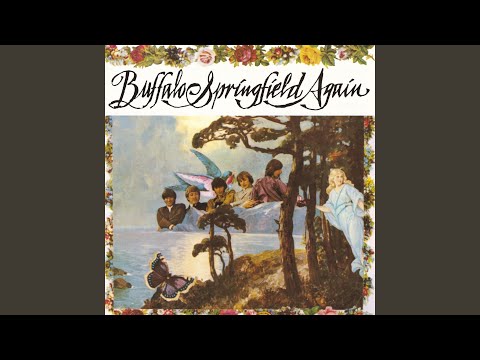
The song appeared on Buffalo Springfield Again, the group's second album, released in November 1967, which is broadly considered one of the essential American rock albums of the 1960s. In that context, "Bluebird" functioned as one of the album's centerpieces, a demonstration of what the band could accomplish when given more than three minutes and a commercial brief. The album's critical stature has only grown over the decades, and the song's reputation has grown with it. Buffalo Springfield dissolved in 1968, making their output a brief and brilliant window that subsequent careers in Crosby, Stills, Nash and Young, and Neil Young's solo work would only partially explain. "Bluebird" stands as evidence of what was lost when they split.
The Longer View
In the years since the band's breakup, music historians and critics have returned repeatedly to the Buffalo Springfield catalog, and "Bluebird" consistently appears near the top of any serious assessment of their work. The song's structural ambition, its refusal to settle for the easy pop format, and the quality of the musicianship throughout have all aged exceptionally well. For a record that peaked at number 58 and spent just seven weeks on the chart, its critical footprint is disproportionately large, which says something genuine about the difference between commercial performance and artistic impact. The musicians who passed through Buffalo Springfield, including Neil Young, Stephen Stills, and Richie Furay, went on to shape the sound of American rock across the entire following decade. Every time a listener discovers those subsequent careers and traces them back to their source, they find "Bluebird" waiting, fully formed and still restless. Press play and hear ambition and beauty sharing a few minutes of borrowed time.
"Bluebird" — Buffalo Springfield's singular moment on the 1960s charts.
02 Song Meaning
Bluebird — Meaning and Cultural Legacy
Freedom as Longing
The bluebird is an image with deep roots in American folklore and popular song, carrying connotations of happiness, freedom, and the elusive nature of both. When Stephen Stills invoked it in 1967, he was connecting to that tradition while tilting it toward something more specifically countercultural. The song's narrator addresses the bluebird with a yearning that is also a kind of instruction, urging the creature onward, suggesting that the freedom it embodies should not be surrendered. The central metaphor works as an exhortation to remain unconfined, to resist the pressures that would tether or define, which resonated powerfully with the Summer of Love's spirit of liberation.
Musical Structure as Meaning
One of the most interesting things about "Bluebird" is the way its formal structure enacts its thematic content. The song moves through sections with a restlessness that mirrors the freedom it describes; it does not settle into a single groove and stay there. The extended instrumental passages, particularly in the album version, create space that feels genuinely open, unscheduled, free of commercial obligation. The structure was itself an argument for artistic liberation at a moment when the album format was beginning to challenge the pop single as the primary unit of musical expression.
The California Counterculture Context
Los Angeles in 1967 was a specific creative ecosystem. The Sunset Strip scene had produced a generation of bands who were simultaneously chasing commercial success and straining against the limitations that success imposed. Buffalo Springfield occupied an uncomfortable position within that world: too musically sophisticated for pure pop radio, too commercially oriented to fully embrace the underground. "Bluebird" embodies that tension, reaching for a kind of musical freedom while packaged as a single intended for mainstream chart competition. The number 58 chart peak suggests the tension was not fully resolved in the market's favor.
Stills as Songwriter and Bandleader
The song is a showcase for Stephen Stills's compositional ambitions at the moment before those ambitions found their most famous outlet. His subsequent work with Crosby, Stills and Nash, and later with Neil Young, would produce more commercially successful records, but some of the adventurousness evident in "Bluebird" would be tempered by the requirements of those larger commercial enterprises. The Buffalo Springfield years represent Stills at his most unconstrained, writing and arranging for a band where the creative chemistry was uniquely volatile. The song captures that creative electricity in concentrated form.
Why It Still Matters
The cultural significance of "Bluebird" has never depended on its chart position. Its reputation rests on its musical ambition, its thematic coherence, and its place within one of the essential catalogs of the 1960s rock era. For listeners who come to the song through Buffalo Springfield Again, it functions as a kind of manifesto: proof that American rock music in 1967 was capable of reaching toward complexity without losing emotional directness. That combination has not become less impressive with time.
→ More from Buffalo Springfield
View all Buffalo Springfield hits →
→ More from the 1960s File
View all 1960s hits →




Keep digging