The 1950s File Feature
Only Sixteen
"Only Sixteen" — Sam Cooke A Voice That Changed Everything, a Song That Charmed Everyone The summer of 1959 in America had a particular sonic quality: the ju…
01 The Story
"Only Sixteen" — Sam Cooke
A Voice That Changed Everything, a Song That Charmed Everyone
The summer of 1959 in America had a particular sonic quality: the jukebox in every diner and the transistor radio held to every teenager's ear were delivering a steady stream of records that felt genuinely new, the product of a popular music landscape in rapid and thrilling transformation. Sam Cooke was one of the central figures in that transformation. He had arrived in secular pop just two years earlier, having made his name in gospel as the lead voice of the Soul Stirrers, and his early pop recordings had already demonstrated that his vocal gifts were extraordinary by any standard. "Only Sixteen," released in 1959, arrived in that context as something lighter and more playful than the dramatic showcases that had established him, and its charm was irresistible.
Cooke's Early Pop Career
Sam Cooke's transition from gospel to pop recording was one of the most consequential career moves in American music history. When he signed with Keen Records and released "You Send Me" in 1957, the record went to number one and announced the arrival of a performer whose voice combined technical purity with emotional warmth in a way that crossed genre lines with apparent ease. By 1959, he had moved to RCA Victor, one of the major labels of the era, and was building the commercial foundations of what would become one of the most influential catalogs in popular music.
"Only Sixteen" was written by Barbara Campbell, a pseudonym that has been connected to Cooke himself and his associates in various accounts. The song is a gentle, nostalgic piece of storytelling, a narrator reflecting on a youthful romance with the warm clarity that comes from years of distance. The production placed it squarely in the pop mainstream of its moment, with a light orchestral arrangement and Cooke's voice in the center, carrying the narrative with the effortless grace that distinguished everything he recorded.
The Chart Run of Summer 1959
The song debuted on the Billboard Hot 100 on June 8, 1959, at position 71, beginning a steady climb through the summer weeks that reflected how pop radio worked in that era: a gradual build driven by radio exposure and word of mouth rather than the compressed debut-spike dynamics that digital platforms would later create. The track moved steadily through the sixties and fifties through June and into July, gathering momentum week by week.
The peak arrived during the week of July 13, 1959, at number 28, after 10 weeks on the chart. That position, in the lower third of the top 40 but still a genuine national chart placement, reflects the song's appeal to the broad teen pop audience of the era while acknowledging that Cooke's more ambitious work was already beginning to point toward something beyond the conventions of the teen ballad format.
The Voice Behind the Lightness
One of the interesting things about "Only Sixteen" in retrospect is what it demonstrates about Cooke's range as a performer. By 1959 he was already being recognized as one of the most gifted vocalists in American popular music, but his reputation rested primarily on his ability to inhabit deeply felt, spiritually inflected material. "Only Sixteen" asked him to do something different: to be charming rather than transcendent, to make a light-hearted nostalgia piece feel genuine without overpowering it with the full force of his instrument.
He accomplished that adjustment with what appears to have been complete ease. The performance is warm and relaxed, the voice perfectly calibrated to the song's modest emotional temperature. That kind of control, the ability to hold back as much as to project, is as demanding a skill as the ability to fill an auditorium with sound.
A Step in a Remarkable Journey
Placed within the arc of Sam Cooke's career, "Only Sixteen" is one of the stepping stones between his arrival in secular pop and the recordings that would come to define his legacy: "Chain Gang," "Twistin' the Night Away," "Another Saturday Night," and ultimately "A Change Is Gonna Come," the 1964 masterwork that reached far beyond the commercial pop world into the realm of genuine social statement. Each of those later records was made possible by the commercial foundation Cooke was building in 1959, song by song, week by week on the chart.
"Only Sixteen" is a small but genuine piece of that foundation. Press play, close your eyes, and hear one of the twentieth century's greatest voices in the easy pleasure of a summer song.
"Only Sixteen" — Sam Cooke's singular moment on the 1950s charts.
02 Song Meaning
"Only Sixteen" — Sam Cooke
Nostalgia as a Simple and Honest Art Form
Not every great song needs to be about something vast. Some of the most durable pieces in the popular music canon are about small, specific, universally recognizable moments: the precise quality of a particular afternoon, the memory of a feeling that was sharp once and has softened with time. "Only Sixteen" by Sam Cooke belongs to that tradition. The song is about remembering a youthful romance from the adult perspective of someone who loved it without fully understanding it at the time, and its power comes entirely from its simplicity and its sincerity.
Youth, Innocence, and the Limits of Understanding
The narrator of "Only Sixteen" is in an interesting position. He is looking back at a moment he was too young to appreciate fully, and he knows it. The song acknowledges explicitly that the person he was at sixteen lacked the emotional capacity to understand what he had. That kind of retrospective self-awareness is a more sophisticated emotional stance than most teen pop of 1959 was attempting, and it gives the track a dimension beyond simple romance. The narrator is mourning not just a lost relationship but a lost self, the person he was before experience complicated things.
Sam Cooke delivers this theme with the warm, slightly rueful tone it requires. His voice does not push too hard on the emotional content; it lets the feeling breathe. That restraint is part of what makes the performance last.
The Teen Ballad Format and What Cooke Did With It
By 1959, the teen ballad was a well-established commercial format, and most artists working within it simply hit the expected emotional marks without attempting anything particularly distinctive. Cooke used the format's constraints productively. The simplicity of the arrangement forced the performance to carry all the emotional weight, and Cooke's voice was more than equal to the task. The result is a song that sounds like its genre but feels more considered than genre exercises usually manage.
The lightness of the production, the pop orchestra understating its presence behind a voice that could have dominated any arrangement, also reflects a period in American popular music before production complexity became a competitive variable. Songs were made to be heard on AM radio through small speakers, and the directness of approach that context demanded produced a kind of clarity that later, more elaborately produced recordings sometimes struggle to match.
Youth Culture and American Pop in 1959
The song arrived in the context of a popular music landscape that was still negotiating the implications of rock and roll's emergence in the mid-1950s. The teen audience had become the dominant commercial force in American pop, and the record industry was producing enormous quantities of material aimed at addressing that audience's emotional preoccupations: romance, identity, the particular intensity of adolescent feeling. "Only Sixteen" fit precisely within that framework while managing to speak to it with more genuine feeling than much of its competition.
The song peaked at number 28 on the Billboard Hot 100 during the week of July 13, 1959, a solid commercial result for a recording that was competing for summer radio time alongside a wide range of teen-oriented material. Its 10-week chart run reflected consistent rather than explosive audience engagement, the kind of result that comes from a song genuinely liked rather than briefly sensational.
The Song in Cooke's Larger Legacy
In the context of Sam Cooke's full catalog, "Only Sixteen" represents the commercial pop craftsman aspect of a multifaceted artist whose range extended from gospel ecstasy to social protest to pure pop confection. The ability to inhabit all of those modes with equal conviction is part of what makes Cooke's recorded legacy so remarkable. "Only Sixteen" is not his most ambitious recording, but it is evidence of his versatility, his capacity to meet a modest song on its own terms and make it memorable through the quality of the performance alone. That is a specific and valuable skill, and Cooke possessed it in full.
→ More from Sam Cooke
View all Sam Cooke hits →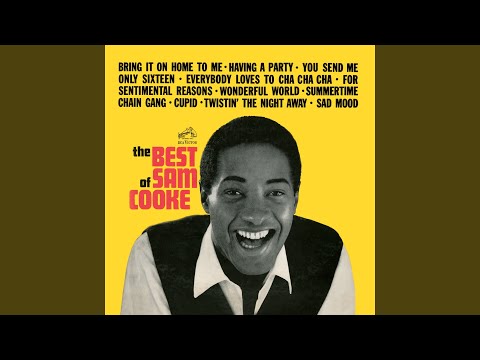



→ More from the 1950s File
View all 1950s hits →

Keep digging