The 1960s File Feature
Bring It On Home To Me
Bring It On Home to Me: Sam Cooke and the Architecture of Longing When Sam Cooke recorded "Bring It On Home to Me" in early 1962, he was already one of the m…
01 The Story
Bring It On Home to Me: Sam Cooke and the Architecture of Longing
When Sam Cooke recorded "Bring It On Home to Me" in early 1962, he was already one of the most celebrated vocalists in American popular music, a gospel-trained singer who had made the crossing from the sacred to the secular in 1957 with "You Send Me" and had spent the intervening years building one of the most impressive bodies of recorded work in the soul era. "Bring It On Home to Me" extended that legacy with a recording that many critics and fellow musicians have come to regard as one of the most emotionally transparent performances in his discography.
The song was written by Cooke himself and recorded for RCA Victor Records, which had signed him in 1960 following his departure from Specialty Records. The RCA period represented a commercial and artistic maturation, with Cooke navigating the complex demands of mainstream pop accessibility and the deeper emotional vocabulary he had developed through years of gospel performance. "Bring It On Home to Me" found a particularly successful balance between those poles, producing a record that was simultaneously commercially appealing and artistically uncompromising.
The recording features what has become one of the most celebrated call-and-response structures in the soul canon. Lou Rawls, then a relative newcomer who would go on to his own distinguished career, contributed the answering vocal part that transforms the song from a solo declaration into a dialogue. The interplay between Cooke's lead and Rawls's response created a dynamic that drew directly on the church tradition of call and response between preacher and congregation, bringing the emotional architecture of gospel into a secular love song context with remarkable effectiveness. The production, led by Hugo and Luigi and arranger René Hall, surrounded the vocal performance with a spare, piano-driven arrangement that gave the voices room to breathe and communicate.
"Bring It On Home to Me" was released as a double A-side single with "Having a Party" in June 1962. The pairing was a commercial masterstroke, placing a celebratory, up-tempo number alongside the introspective ballad and giving radio programmers and listeners a choice of entry points into Cooke's artistry at that particular moment. The strategy worked: the single performed strongly, with "Bring It On Home to Me" reaching number 13 on the Billboard Hot 100 and number 2 on the R&B charts, a performance that confirmed Cooke's continued relevance in both the mainstream pop market and his core R&B audience.
The song's cultural footprint expanded dramatically through the subsequent decades as a remarkable number of significant artists chose to record their own versions. The Rolling Stones, Animals, Priscilla Coolidge, Tex Ritter, and many others all recorded covers that acknowledged the song's emotional power and compositional strength. The fact that artists across rock, country, and folk traditions found "Bring It On Home to Me" equally compelling testifies to the universality of its emotional premise, which transcends the specific genre conventions of early 1960s soul music.
Cooke performed the song frequently in his live shows, where its call-and-response structure made it particularly effective as a vehicle for audience participation. Recordings and contemporaneous accounts of these performances suggest that he understood the song's power as a live event, a communal sharing of the longing and vulnerability it described, in ways that studio recordings could only partially capture. His Live at the Harlem Square Club, 1963 album, recorded but not released commercially until 1985, contains a performance of the song that many regard as definitive, a raw and unguarded version that contrasts sharply with his more polished studio recordings.
Within the longer arc of Cooke's brief career, "Bring It On Home to Me" occupies a central place as evidence of his capacity for emotional depth and his understanding of the gospel tradition's potential to animate secular material. The song demonstrates that the transition from sacred to secular music need not require a reduction in emotional intensity; properly handled, the gospel vocabulary could carry the weight of romantic longing just as effectively as it carried theological devotion. This insight, which Cooke embodied more fully than almost any other artist of his generation, shaped the entire subsequent development of soul music as a genre.
02 Song Meaning
The Gospel of Return: Longing and Vulnerability in "Bring It On Home to Me"
"Bring It On Home to Me" is one of the most emotionally direct recordings in Sam Cooke's catalog, a song in which the usual layers of showmanship and craft that characterize his work are stripped back to reveal something close to unmediated feeling. The song's subject is return: the pleading of a person who has been abandoned by a romantic partner and who is asking, with great emotional economy, for that partner to come back. The simplicity of this premise allows the performance to carry the full weight of the emotion without the distraction of elaborate narrative.
Cooke structures the emotional arc of the song as a confession of need. The person speaking acknowledges that they gave something up, that they made mistakes, and that the cost of those mistakes is the absence of the person they love. This admission of fault is not typical of the romantic boastfulness that characterized much popular music of the early 1960s. Cooke's willingness to render male vulnerability in such transparent terms was partly a product of his gospel background, in which humility before a higher power was the baseline emotional posture, and partly a personal artistic choice that distinguished his work from many of his contemporaries.
The call-and-response format that Lou Rawls's answering vocal creates is not incidental to the song's meaning but central to it. The device, drawn directly from Black church tradition, suggests that the speaker's longing is not simply a private emotion but something that resonates outward, that finds an echo in a community of shared experience. The answering voice transforms the solo confession into a conversation, and by extension into a communal acknowledgment that this kind of longing is universal, that everyone in the congregation, or the audience, knows what it feels like to want someone to come home.
The setting of a love song in the emotional vocabulary of gospel prayer was a deliberate and transformative artistic decision. Cooke had grown up in the church, trained his voice in the gospel tradition, and built his earliest public profile as a sacred singer. When he moved into secular music, he did not abandon that vocabulary but repurposed it, treating romantic love as something sufficiently serious and sufficiently transcendent to warrant the same emotional investment that gospel demands. This approach gave his romantic recordings a depth and a weight that distinguished them from the lighter confections that dominated much of the pop landscape in the early 1960s.
The song's influence on subsequent generations of soul and R&B artists has been immense. The emotional template it established, male vulnerability expressed through gospel-inflected vocal technique in a sparse, piano-driven arrangement, can be heard in the work of artists ranging from Al Green and Otis Redding to later figures like John Legend and Sam Smith. The track defined one of the core emotional registers of soul music as it developed through the 1960s and beyond, the combination of romantic pleading and spiritual depth that marks the genre at its most powerful.
In the context of Cooke's own life and the tragic circumstances of his death in December 1964, "Bring It On Home to Me" has acquired an additional layer of retrospective meaning. The vulnerability and emotional openness he displayed in the recording now read, to some listeners, as a glimpse of the private person behind the polished public performer, a man capable of the kind of honesty that the song requires. Whether or not that biographical reading is fair to the artistic work, it has shaped how the song is heard and how it is remembered, as something more than a beautiful recording and something close to a document of a genuinely extraordinary artistic personality encountering a genuinely universal human emotion and finding, in his own voice and tradition, exactly the right words to express it.
→ More from Sam Cooke
View all Sam Cooke hits →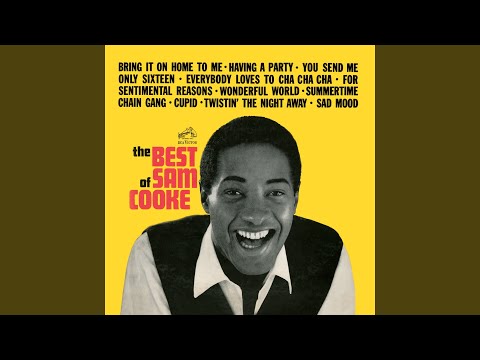



→ More from the 1960s File
View all 1960s hits →




Keep digging