The 1950s File Feature
Little Queenie
"Little Queenie" — Chuck Berry Rock and Roll's Architect, Still Building Spring 1959, and the rock and roll revolution that Chuck Berry had helped ignite was…
01 The Story
"Little Queenie" — Chuck Berry
Rock and Roll's Architect, Still Building
Spring 1959, and the rock and roll revolution that Chuck Berry had helped ignite was already three years into its commercial dominance. The music that had seemed scandalous and transient to cultural critics in 1956 had proved durable enough to reshape the entire popular music industry, and Berry himself had become one of its defining figures. His guitar riffs, his stage moves, his lyrical fixation on cars and girls and freedom, all of it had been adopted, consciously or otherwise, by an entire generation of performers on both sides of the Atlantic. In this context, releasing another single was not simply a commercial act but a continuation of something that was already shaping the sound of the century.
"Little Queenie" arrived in this environment, entering the Billboard Hot 100 on April 13, 1959, debuting at number 98. Its chart trajectory was somewhat erratic, moving to 81 in its second week, dipping to 93 in the third week, then recovering to reach its peak position of number 80 on May 11, 1959, the fourth and final week of its four-week chart run. The modest chart performance understated the song's cultural significance, which operated at a level the Hot 100 alone could not measure.
The Chess Records Workshop
Chuck Berry's recordings were made at Chess Records in Chicago, the independent label that had become one of the most important institutions in American popular music through the late 1940s and 1950s. Chess Records, founded by Leonard and Phil Chess, had built a roster that included Muddy Waters, Howlin' Wolf, Etta James, and Little Walter alongside Berry, making the label's output an essential document of the period's Black musical innovation. Berry's relationship with the label and its producers shaped his sound in ways that distinguished it from rock and roll being made elsewhere.
The house musicians and producers at Chess understood how to capture what Berry was doing and translate it into recordings that retained the energy of live performance while meeting the technical standards of the era's radio broadcasts. Berry's own guitar work was the central element of every recording, but the rhythm section backing him, with its characteristic Chicago-blues-influenced approach to rhythm and groove, gave the records a physical foundation that lesser studio environments might not have provided.
The Architecture of a Berry Song
"Little Queenie" demonstrated Berry's characteristic approach to songwriting at a point when that approach had been refined to near-perfection. The guitar introduction, the subject matter involving a young woman spotted from a distance and admired, the narrative voice that balanced confidence with playful uncertainty, all of these elements were distinctly Berry's own while also being sufficiently universal to invite identification from virtually any listener of the appropriate demographic.
Berry's genius as a lyricist was his ability to be simultaneously specific and general: specific enough that the scene felt observed rather than imagined, general enough that the listener could insert their own version of the scenario. This technique, applied consistently across his catalog, explained why his songs proved so durable as covers: any artist could plausibly make the same observations, because the observations themselves were recognizable experiences rather than unique biographical events.
A Catalog at Its Peak
By 1959 Berry had already released an extraordinary string of records: "Maybellene" in 1955, "Roll Over Beethoven" and "Too Much Monkey Business" in 1956, "School Day" and "Rock and Roll Music" in 1957, "Johnny B. Goode" and "Carol" in 1958. "Little Queenie" arrived in the context of this rapidly accumulating canon, another entry in a body of work that was already recognized by critics and musicians as foundational. The fact that its chart performance was modest by the standards of his biggest hits did nothing to diminish its importance as a document of the form.
The song's subsequent life in the repertoire of rock bands who covered it, including most famously the Rolling Stones, whose live performances of it became legendary, demonstrated that its value had little to do with its original chart position. The Stones' performances of "Little Queenie", capturing the song's combination of cool observation and physical momentum, helped cement its status as a Berry essential rather than a minor chart entry.
The Enduring Blueprint
Chuck Berry's work from the mid-1950s through 1959 functioned as a master class in what rock and roll could do: it was rhythmically exciting, lyrically specific, melodically memorable, and performed with a technical and personal authority that no one in the genre has since fully equaled. "Little Queenie" belongs to that body of work as a characteristic example of the form. Press play and hear where the blueprint came from.
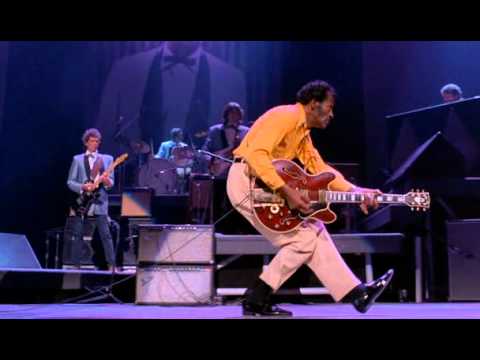
"Little Queenie" — Chuck Berry's singular moment on the 1950s charts.
02 Song Meaning
"Little Queenie" — Themes and Legacy
The Teenager as Subject and Audience
Chuck Berry invented, or at minimum perfected, a specific type of rock and roll songwriting: the song about being young, with a young person's desires, freedoms, and attention spans, addressed directly to young listeners who recognized themselves in it. "Little Queenie" operates precisely within that mode. The scene it sets, a young man watching an attractive young woman at a record store or dance, waiting for the right moment to approach, is a near-universal teenage experience rendered with the specificity and humor that Berry brought to everything he observed. The song knew its audience completely and the audience knew it back.
This direct address to the teenage listener was not merely a commercial strategy, though it was certainly that too. It represented a genuine shift in popular music's understanding of who its primary audience was and what that audience wanted to hear about. Before rock and roll, popular music largely addressed an adult audience with adult concerns. Berry, alongside a handful of other architects of the form, reoriented the conversation toward youth itself, treating adolescent experience as worthy of serious artistic attention.
Cool Observation and Physical Energy
What distinguishes the best Berry songs from lesser rock and roll of the period is the combination of detached observational cool with genuine physical energy in the playing. Berry describes the girl he's watching with the slightly removed perspective of the observer who is trying to calculate his approach, and that perspective gives the song a dry wit not typical of the more earnest romantic pop of the era. At the same time, the guitar work and the rhythmic drive of the recording are unmistakably physical, demanding a bodily response from the listener even as the lyrical narrator maintains his calculated cool.
This productive tension between cool and heat was one of the defining characteristics of Berry's mature style, and it influenced an enormous number of subsequent rock musicians. The combination of wit and groove, the sense that you could be smart and sexy simultaneously, became a template that artists from the Rolling Stones to the Talking Heads explored in different ways across the following decades.
The Cover Tradition and What It Reveals
A song's power can be measured by what happens when other artists take it over. "Little Queenie" attracted covers from artists including the Rolling Stones, who made it a regular feature of their live sets in the late 1960s and early 1970s, and whose performances of it demonstrated what they had learned from Berry about the relationship between rhythm guitar, lead guitar, and physical performance energy. The Stones' engagement with Berry's catalog was explicit and admiring, and Mick Jagger and Keith Richards were both candid about his foundational importance to their own work.
The Rolling Stones' version, captured on various live recordings, approached the song with the reverence of musicians who understood that they were working from a master template. Their ability to convey that understanding while also making the material feel alive and present rather than nostalgic spoke to the song's inherent vitality. Good templates remain productive across generations precisely because they encode principles rather than merely surface features.
Legacy in Rock's DNA
Chuck Berry's influence on rock and roll's development is so pervasive as to be almost invisible: his innovations have been so thoroughly absorbed by the musicians who followed him that they have become the grammar of the form rather than recognizable citations. The double-stop guitar figures, the narrative lyrical approach, the combination of blues rhythmic structure with pop melodic values, these are not Berry's alone any longer because they belong to everyone who has played in the tradition he helped create.
"Little Queenie" encapsulates that foundational work in miniature: four weeks on the Hot 100, modest by chart standards, but carrying a genetic charge that propagated through the entire subsequent history of rock. Its position in the Berry canon as a song that informed an extraordinary number of subsequent artists makes it more significant than its original peak position suggested. The measure of foundational work is not its chart performance but what grows from it, and what grew from Chuck Berry's late-1950s recordings remains impossible to fully catalog.
→ More from Chuck Berry
View all Chuck Berry hits →



→ More from the 1950s File
View all 1950s hits →


Keep digging