The 2000s File Feature
E-Pro
"E-Pro" — Beck's Motorik Broadside and the Sound of Guero The Return of Beck By 2005, Beck Hansen had accumulated one of the most genuinely strange career tr…
01 The Story
"E-Pro" — Beck's Motorik Broadside and the Sound of Guero
The Return of Beck
By 2005, Beck Hansen had accumulated one of the most genuinely strange career trajectories in popular music, a run that included lo-fi folk, hip-hop-inflected slacker anthems, elaborate chamber pop, and late-night funk odysseys, all without settling into any single commercial identity. When Guero arrived in March 2005, it was partly received as a return to the visceral guitar-based energy of his early work. "E-Pro," the album's opener and lead single, announced this intent immediately: a thunderous, distortion-forward track built on a riff that felt simultaneously new and familiar. It debuted on the Billboard Hot 100 on March 26, 2005, at position 77, climbed to 65 as its peak on April 16, and spent 10 weeks on the chart.
Dust Brothers and the Architecture of the Track
The creative partnership behind "E-Pro" had deep roots. Beck co-produced the track with the Dust Brothers, the Los Angeles-based production team of John King and Michael Simpson, whose work with Beck on Odelay in 1996 had helped define what sample-based alternative rock could accomplish. The Dust Brothers had also produced the Beastie Boys' Paul's Boutique, a landmark of collage-based production, and their sensibility, the art of assembling disparate sounds into a coherent kinetic energy, was fully evident on "E-Pro."
The track's most immediately recognizable element is its rhythm, which draws on the motorik style associated with German krautrock bands like Neu! and Kraftwerk: a relentless, metronomic pulse that drives forward without conventional rock dynamics. Over this, Beck and the Dust Brothers layer guitar distortion, processed vocals, and rhythmic elements that give the track an almost mechanical forward momentum. The sonic debt to artists like Neu! is a matter of record rather than speculation, as Beck has discussed his interest in krautrock influences openly.
Lyrical Posture and Energy
Beck's vocal approach on "E-Pro" is confrontational in a way that much of his catalog avoids. The song carries a combative, defiant energy that suits the production's aggressive textures. The lyrics deal in a kind of irreverent bravado, delivered with the particular confidence of someone who has nothing left to prove commercially and can therefore afford to be purely expressive. The refrain is one of Beck's most memorable hooks, a fragment of language that works as rhythmic propulsion as much as semantic content. This was in keeping with Beck's approach to language generally: words as sound objects, as rhythm units, as emotional signals rather than literal statements.
Chart Performance and Radio Context
A Hot 100 peak of 65 and a ten-week run was a solid showing for a track so aggressively unconventional by the standards of mid-2000s pop radio. The landscape in spring 2005 was dominated by pop and hip-hop acts, and a distortion-heavy alternative rock single cracking the top 65 represented genuine crossover appeal. The track also performed well on the Modern Rock and Mainstream Rock charts, where it reached higher positions and demonstrated Beck's durability as an alternative radio presence.
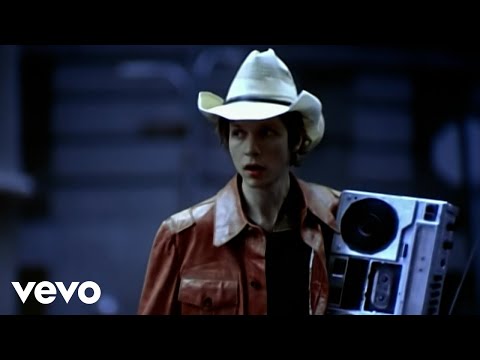
The music video, directed by filmmaker Michael Gondry, was a visual counterpart to the song's energy: colorful, kinetic, technically inventive. Gondry's approach, which drew on optical illusions and in-camera tricks rather than digital effects, suited the song's simultaneously modern and retro aesthetic. The collaboration between Beck and Gondry was an artistically productive one that extended across several videos.
Place in Beck's Catalog
Guero was recorded in part as a response to Sea Change (2002), Beck's stark, introspective breakup album that had moved in a very different emotional direction. "E-Pro" functions as a kind of reset, a reestablishment of the restless, genre-jumping Beck who made Odelay and Midnite Vultures. For listeners who had followed his career through multiple stylistic reinventions, the track was a welcome signal that the capacity for noise and humor and motor-energy had not been left behind.
The song remains among the more immediately recognizable entries in Beck's catalog, the kind of track that gets used in film trailers and sports broadcasts precisely because its energy is so declarative. Press play and feel the grid lock in.
"E-Pro" — Beck's singular moment on the 2000s charts.
02 Song Meaning
"E-Pro" — Defiance, Momentum, and the Grammar of Noise
Aggression as Artistic Statement
In a catalog defined by tonal mobility, "E-Pro" is notable for its commitment to a single emotional register: defiant forward momentum. The track does not modulate between moods or explore contradictions within a single listening experience. It drives. The aesthetic choice to open Guero with this particular kind of energy was a declaration of intent from Beck, signaling that the introspective quietness of Sea Change was being set aside in favor of something noisier and more extroverted. The song's themes are inseparable from its sonic character; the aggression in the production is the message as much as any lyrical content.
The Machine Aesthetic and Human Energy
The motorik rhythm that anchors "E-Pro" carries its own set of cultural meanings. The style originates with German rock bands of the early 1970s who were deliberately rejecting the backbeat-heavy American rock template in favor of something more mechanical and hypnotic. Beck and the Dust Brothers brought this European machine-music aesthetic into contact with American noise rock and hip-hop production values, producing a hybrid that sounded simultaneously like an old record and a new one. This kind of productive collision between traditions was Beck's signature move, but "E-Pro" executes it with unusual directness and force.
The Mid-2000s Alternative Rock Landscape
In 2005, alternative rock as a commercial category was in a complicated position. The grunge and post-grunge waves had receded, leaving a landscape populated by a range of acts without a unifying aesthetic. Beck occupied a unique position within this context, respected enough to have genuine credibility with both indie audiences and mainstream rock listeners, unconventional enough that his commercial success always felt contingent rather than guaranteed. "E-Pro" worked within this environment partly because it sounded like nothing else in heavy rotation, its krautrock DNA and hip-hop production sensibility setting it apart from the prevailing sounds of rock radio.
The song also benefited from the music video culture of the mid-2000s, when MTV and music video channels were still significant cultural distributors, though streaming and YouTube were beginning to change the equation. Michael Gondry's visual contribution gave the song a presence beyond radio, a distinctive moving image to accompany the distinctive sound.
Legacy Within Beck's Work
The track's function within Beck's broader artistic project is worth noting. His career involves a sustained inquiry into what popular music can be made from: what sounds, traditions, genres, and cultural materials can be combined to produce something new. "E-Pro" represents one answer to that inquiry, the answer that involves German minimalism, American noise, and hip-hop production fused into three-and-a-half minutes of kinetic rock music. The fact that the answer reached number 65 on the Hot 100 suggests that the fusion was not too conceptual for mass appeal.
Listeners drawn to "E-Pro" tend to be those who find something satisfying in music that commits fully to its own logic, that doesn't hedge or apologize or seek to be palatable. The song is what it is with complete conviction, and in a musical culture that often values flexibility over commitment, that quality has a lasting appeal all its own.
→ More from Beck
View all Beck hits →

→ More from the 2000s File
View all 2000s hits →




Keep digging