The 1980s File Feature
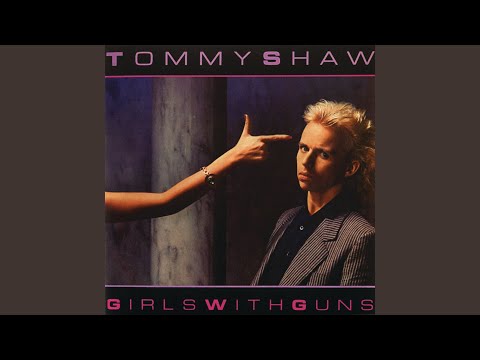
Girls With Guns
"Girls With Guns" — Tommy Shaw Steps Out From Styx's Shadow Leaving the Arena Behind By the autumn of 1984, Tommy Shaw had a decision behind him that many ro…
01 The Story
"Girls With Guns" — Tommy Shaw Steps Out From Styx's Shadow
Leaving the Arena Behind
By the autumn of 1984, Tommy Shaw had a decision behind him that many rock musicians in his position would have found paralyzing. Styx, the band he had joined in the mid-1970s and helped elevate to arena-rock dominance, had fractured. The acrimonious events surrounding the Kilroy Was Here album and tour had left relationships within the band strained to the breaking point. Shaw departed, and with him went one of Styx's primary melodic voices and songwriting contributors. What he carried into his solo career was considerable: a gift for hooks, a rock-solid sense of arrangement, and an audience that already knew his name and his voice.
Girls With Guns, his debut solo album, arrived in 1984 carrying the weight of those expectations and the energy of an artist who had something to prove in a new context. The rock landscape of that year was generous to guitarists with strong songwriting credentials; the MTV era had created pathways for artists who could translate their sound into compelling visual presentation, and Shaw had the looks and the production instincts to navigate that environment effectively.
The Title Track and Its Energy
"Girls With Guns" as a song functions almost as a mission statement for Shaw's solo ambitions. The track is built on a driving guitar riff, propelled by a rhythm section that prioritizes momentum over subtlety. The production leaned into the polished hard rock aesthetic that dominated rock radio in 1984, with enough shine to fit comfortably alongside the Loverboy and Foreigner singles that populated playlists that season while maintaining enough edge to satisfy listeners who might have found the smoothest end of adult contemporary rock too safe.
Shaw's vocal is front and center throughout, demonstrating the range that had made him invaluable to Styx's layered harmony work and showing what that voice could do in a more exposed solo context. The track also allowed him to foreground his guitar work, which during the Styx years had sometimes been subordinated to the band's keyboard-heavy arrangements. Here the guitar drives the track from the opening measures.
Twelve Weeks on the Chart, Peaking at 33
The single entered the Billboard Hot 100 on September 29, 1984, debuting at number 76. Its climb through the fall was steady, gaining traction on album-oriented rock radio where Shaw's Styx association gave him immediate credibility. By November 17, 1984, "Girls With Guns" had climbed to its peak position of number 33, a strong showing for a debut solo single from a member of a band whose own chart performance had been concentrated on album sales rather than Hot 100 dominance. The track spent 12 weeks total on the Billboard Hot 100, establishing Shaw's solo viability in concrete commercial terms.
On the album-oriented rock chart, where Shaw's audience was most concentrated, the single performed even more strongly. AOR programmers embraced the track's guitar-driven energy and Shaw's familiar vocal, and their enthusiasm helped sustain the pop chart run longer than radio momentum alone might have carried it.
The Art of the Solo Debut
Launching a solo career after membership in a major band involves navigating a specific set of audience expectations. Listeners who came to Shaw through Styx brought preconceptions about the kind of music he made, some of which fit his solo material and some of which required gentle correction. The challenge was maintaining continuity with what his audience already loved while making clear that the new project had an identity separate from the band context.
"Girls With Guns" accomplished that balance reasonably well. It was recognizably the work of someone from the arena-rock tradition without being a Styx record. The production choices, the sonic signature, and the tone of the performance all suggested an artist charting a direction that had its own logic, even if it did not represent a radical stylistic departure from familiar territory.
Rock's Class of 1984 and Where Shaw Fit
The rock landscape of 1984 was competitive and increasingly defined by visual presentation. Hair metal was ascending, MTV was transforming how rock acts were marketed and perceived, and the line between hard rock and pop was being pushed in directions that would have been unimaginable a decade earlier. Shaw navigated that landscape with pragmatism, understanding that commercial viability required engagement with the era's visual and sonic conventions without wholesale abandonment of his core musical identity.
The fact that "Girls With Guns" made the top 40 of the Hot 100 in that context confirms that Shaw had correctly read both his audience and his moment. Let the opening riff remind you of what a rock hook sounded like when the stadiums were full and the radio was loud.
"Girls With Guns" — Tommy Shaw's singular moment on the 1980s charts.
02 Song Meaning
"Girls With Guns" — Power, Bravado, and the Mythology of 1984 Rock
Reading the Image
The title "Girls With Guns" operates primarily as an image rather than a literal description, deploying the juxtaposition of femininity and weaponry for its provocative charge. As a piece of rock mythology, the phrase belongs to a tradition of songs that use dramatic, slightly transgressive imagery to create a sense of charged excitement. The combination of the playful and the dangerous was standard-issue hard rock vocabulary in 1984, a year when the genre's visual and lyrical language was becoming increasingly stylized and image-dependent.
The aesthetic of the era leaned heavily on surface excitement, on images and sounds that produced immediate visceral response rather than sustained reflection. "Girls With Guns" was fluent in that language. Its title was designed to catch the eye on a record rack and hold it, to create a mental image strong enough to make the potential listener curious about the sound behind it. In the MTV era, where the image often preceded the music in the listener's experience, this kind of title carried strategic weight.
Bravado and the Solo Artist's Posture
For Tommy Shaw, launching a solo career required staking out a persona that was recognizable but independent from his Styx associations. The assertive energy of "Girls With Guns" served that need well. A track built on confident guitar work and an unambiguous hook communicated something specific about the kind of artist Shaw intended to be in this new phase: direct, unequivocal, and comfortable with rock's more visceral pleasures.
Bravado functions differently in rock than in other genres. In the context of 1984 arena rock, a certain amount of theatrical confidence was understood as part of the form rather than as genuine arrogance. Audiences came to rock shows and records partly for the pleasurable simulation of that confidence, for the opportunity to inhabit, briefly, a kind of swagger that everyday life rarely offered. Shaw's track offered that simulation in concentrated form.
The Early-1980s Masculine Mythology in Rock
The rock of 1984 was working through a particular kind of masculine mythology: the lone wolf, the road warrior, the figure who operated on his own terms and attracted admiration precisely because of his refusal to accommodate expectations. That mythology was becoming increasingly codified during this period, solidifying into the hair metal genre's conventions while still retaining some of the original arena rock's more genuinely rebellious energy in the work of artists who predated the formula.
Shaw's history in Styx gave him credentials that positioned him slightly outside the pure hair metal category while still allowing him to benefit from the genre's commercial moment. His songwriting history meant that "Girls With Guns" could be read as a craftsman's work rather than pure pose, the product of someone who understood structure and melody rather than merely deploying the era's surface conventions.
Why the Track Holds Up as a Genre Document
Heard today, "Girls With Guns" functions as a precise document of a specific moment in American rock. Every production choice, every guitar tone, every vocal inflection places it in 1984 with the accuracy of a photograph. That specificity, which could be read as limitation, is also a form of value. The track is not trying to transcend its moment; it is fully and unapologetically of it.
Genre documents have their own form of integrity. A track that fully embodied the values and aesthetics of its cultural moment, that pursued those values skillfully rather than half-heartedly, tells us something real about who we were and what we wanted from music at a particular point in time. "Girls With Guns" does that work honestly, making it worth returning to on those terms if not always on others.
"Girls With Guns" — Tommy Shaw's singular moment on the 1980s charts.
→ More from Tommy Shaw
View all Tommy Shaw hits →

→ More from the 1980s File
View all 1980s hits →
Keep digging