The 1980s File Feature
Pop Song 89
"Pop Song 89" — R.E.M. Surfaces for Air A Band at Its Most Playful In the summer of 1989, R.E.M. occupied a fascinating position in the American rock landsca…
01 The Story
"Pop Song 89" — R.E.M. Surfaces for Air
A Band at Its Most Playful
In the summer of 1989, R.E.M. occupied a fascinating position in the American rock landscape. They had spent most of the decade as the defining band of college radio: oblique, atmospheric, critically adored, and largely indifferent to the kind of mainstream commercial success that would have required compromising the qualities that made them essential to their devotees. By 1989, however, the walls between alternative and mainstream were beginning to develop cracks, and R.E.M.'s audience was quietly enormous even if it did not always register in Billboard terms.
Green, the album from which Pop Song 89 was drawn, represented the band's first album for Warner Bros. Records after their years on I.R.S. Records, and it carried the weight of that transition. Moving to a major label meant new resources and new expectations, but R.E.M. navigated the shift without losing their essential character. Green was the album that began the process of bringing their audience into the mainstream conversation, and Pop Song 89 was its most self-aware gesture toward that process.
The Title as Commentary
The song's title is a piece of meta-commentary built right into the record's identity. Calling something a "pop song" while simultaneously being that thing enacts a gentle irony that was entirely consistent with Michael Stipe's lyrical sensibility at this period of his career. The band had always maintained a certain critical distance from pop convention even while making records that were, at their best, extraordinarily melodic. This track brings that distance into the open, naming the genre while executing it with enough self-awareness to keep the result interesting.
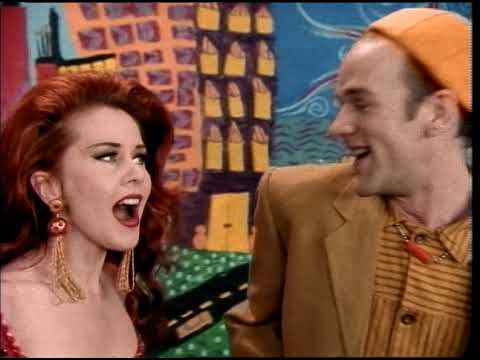
The video for the single, directed by Jem Cohen, featured Stipe discussing topics with actress Wendeline Harston in a manner that referenced Jean-Luc Godard's film Masculin Féminin. For a song appearing on the Billboard Hot 100, this was unusually art-house territory, suggesting that R.E.M.'s mainstream ambitions were always qualified by a commitment to creative integrity that made them incapable of producing fully unironic commercial product.
The Chart Appearance
The single debuted on the Billboard Hot 100 on June 10, 1989, entering at number 93. It spent four weeks on the chart, climbing briefly to its peak position of number 86 during the week of June 24, 1989, before falling away to number 99 in its final charting week. This was not a mainstream pop breakthrough by any standard measure. A four-week run peaking at 86 placed R.E.M. squarely in the territory of cult act with mainstream adjacency rather than genuine crossover success, a position they would leave behind dramatically within two years.
The context makes the chart appearance interesting rather than disappointing. R.E.M.'s primary commercial reality in 1989 was album sales, college radio dominance, and arena touring, not Top 40 placement. The fact that Pop Song 89 appeared on the Hot 100 at all reflects the shifting audience relationship that Green was beginning to build.
Sound and Production
Scott Litt, who co-produced Green with the band, gave the track a cleaner, more accessible sound than some of R.E.M.'s earlier recordings without stripping away the elements that made them distinctive. The jangly guitar textures associated with Peter Buck were present but tidied; Bill Berry's drumming was crisp and forward in the mix; Mike Mills's melodic bass provided both rhythmic foundation and harmonic interest. Stipe's vocal was more intelligibly delivered than on early-period R.E.M. recordings, a shift that had begun with Document and continued through Green.
The song's energy is brighter and more conventionally upbeat than much of the album surrounding it, which lent it a certain single-readiness that the band did not always prioritize. The arrangement is efficient: it gets to its point quickly, makes it, and departs without overstaying its welcome.
The Bridge to Mainstream Recognition
Out of Time in 1991 and Automatic for the People in 1992 would confirm R.E.M. as one of the genuinely significant mainstream rock acts of the decade. Pop Song 89 belongs to the period just before that transformation, when the band was large enough to register on the Hot 100 but still small enough that a peak of 86 was entirely consistent with their commercial profile. The track serves as a marker of the moment when R.E.M. began to consider what mainstream meant for a band with their particular history and values.
Put it on and hear R.E.M. doing exactly what the title promises, on their own terms, with a smile tucked somewhere in the delivery.
"Pop Song 89" — R.E.M.'s singular moment on the 1980s charts.
02 Song Meaning
"Pop Song 89" — Irony, Connection, and the Art of Naming Yourself
The Self-Referential Gesture
There is a particular kind of artistic confidence required to name a work after its own category. Pop Song 89 announces itself before the first note arrives: it is a pop song, it was made in 1989, and it knows what it is. This act of self-naming creates an interpretive frame that shapes how listeners receive the music. Rather than pretending to transcend its genre, the track wears its pop identity openly, inviting the listener to engage with the artifice rather than look past it. The self-awareness built into the title is itself a thematic statement, about honesty in artistic positioning, about the relationship between a band and the commercial categories they inhabit.
R.E.M. had spent most of their career maintaining a productive tension between their instinct for melody and their aversion to the conventions that came with commercial pop. Pop Song 89 names that tension directly. The song does not resolve it; it inhabits it, which is the more interesting artistic choice.
Stipe's Lyrical Territory
Michael Stipe's lyrics in this period were becoming more direct than in the earlier, more opaque phase of R.E.M.'s career. The track engages with communication itself, with the dynamics of conversation and connection between people. Questions about what can and cannot be said between individuals, about the distance that remains even in intimate exchange, are central to the lyric's concerns. The video reinforced this reading, staging its dialogue scenes in a way that emphasized both the desire for connection and the structural obstacles to it.
In the late 1980s, Stipe was developing a more outward-facing artistic identity, moving from the cryptic interiority of early R.E.M. toward a more engaged public stance. The song participates in this transition: it is less private than the band's earlier work without becoming confessional or simplistic. The balance required considerable skill to maintain, and Stipe's performance finds it.
Alternative Culture at the Mainstream Edge
By 1989, the alternative music community that R.E.M. had helped define was beginning to exert significant pressure on the mainstream music industry. College radio had developed into a genuine alternative distribution system, and the artists it championed were accumulating audiences large enough to make major labels pay attention. R.E.M.'s move to Warner Bros. embodied this transition, bringing with it both the resources of a major label and the question of what alternative credentials meant once you accepted mainstream infrastructure.
Pop Song 89 engages with this question through its title and its performance. The song sounds like R.E.M. making a radio-ready piece of music while remaining entirely themselves, which is exactly the challenge their new commercial position required them to solve. The solution they arrived at in 1989 would prove to be a template for the far greater commercial success that followed.
A Document of Creative Self-Examination
Songs that reflect on their own status as pop songs are relatively rare, and successful ones rarer still. The trap is a kind of self-conscious smirk that places the artist above the material, condescending to the genre rather than engaging with it. R.E.M. avoided this trap because the music is genuinely good, melodically satisfying and emotionally present in a way that earns its pop label rather than ironizing it into meaninglessness.
The song functions as both a piece of entertainment and a statement about the nature of entertainment, which was always R.E.M.'s most ambitious mode of operation. That the Hot 100 peak was modest matters less than the fact that the song still rewards listening, still poses its questions with intelligence and care, decades after 1989 has become history.
→ More from R.E.M.
View all R.E.M. hits →

→ More from the 1980s File
View all 1980s hits →
Keep digging