The 1980s File Feature
Get Up And Go
"Get Up And Go" — The Go-Go's Keep Their Momentum Rolling The All-Female Band That Conquered Radio The autumn of 1982 found the Go-Go's at a remarkable posit…
01 The Story
"Get Up And Go" — The Go-Go's Keep Their Momentum Rolling
The All-Female Band That Conquered Radio
The autumn of 1982 found the Go-Go's at a remarkable position in rock history. The previous year, their debut album Beauty and the Beat had reached number one on the Billboard 200, making them the first all-female band who wrote their own songs and played their own instruments to achieve that landmark. The achievement was not merely symbolic: it demonstrated that the rock industry's persistent skepticism about whether women could front a commercially successful guitar band on their own terms was simply wrong.
The group had formed in Los Angeles in the late 1970 in the punk scene, developing a sound that retained the energy and directness of punk while adding melodic hooks that made their music accessible to audiences well beyond the club circuit. By the time they signed to IRS Records and began working with producer Richard Gottehrer on Beauty and the Beat, they had already developed the core elements of their sound: Belinda Carlisle's expressive lead vocals, interlocking guitar parts from Charlotte Caffey and Jane Wiedlin, Kathy Valentine's melodic bass lines, and Gina Schock's driving drums.
Vacation and What Followed
"Get Up And Go" appeared on the Go-Go's second album Vacation, released in July 1982 on IRS Records. The album continued the formula that had made Beauty and the Beat so successful: polished, hook-heavy pop songs with enough edge in the guitar textures and rhythmic attack to satisfy rock audiences while remaining fully accessible to pop radio. Producer Richard Gottehrer returned to work with the band, maintaining the sonic continuity between albums.
The band wrote or co-wrote their material, maintaining the creative ownership that had distinguished them from the more typical industry model of female vocalists performing songs provided by male songwriters and producers. Vacation as an album was received with somewhat less critical enthusiasm than its predecessor, in the common pattern of sophomore albums bearing the weight of extraordinary debut expectations, but it produced several strong singles that demonstrated the band's continued vitality.
Nine Weeks on the Autumn Charts
The single entered the Billboard Hot 100 on September 25, 1982, debuting at position 82. Its climb through the autumn was steady, reaching its peak position of number 50 on October 30, 1982. Nine weeks on the Hot 100 with a top-50 peak represents solid commercial performance, confirming the Go-Go's continued mainstream appeal beyond the initial wave of excitement that had surrounded their debut.
The autumn of 1982 was a creatively rich period on the charts. Michael Jackson's Thriller was still building its extraordinary commercial momentum, new wave acts were achieving significant pop crossover success, and the Go-Go's occupied a distinctive position as a band that bridged punk energy with pop craftsmanship in ways that neither punk purists nor pure pop audiences fully claimed. Fifty on the Hot 100 placed "Get Up And Go" in the upper half of the chart with meaningful airplay exposure.
Energy as Identity
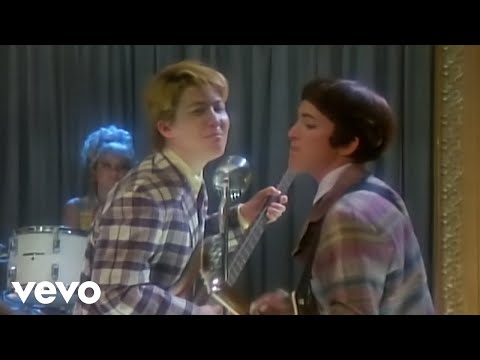
The title "Get Up And Go" encapsulates the Go-Go's characteristic approach to both their music and their public image. The band's visual presentation and stage presence emphasized enthusiasm, humor, and physical energy; their videos showed a group clearly having genuine fun rather than performing the more serious or romantic poses common among their contemporaries. This projected energy was both aesthetically genuine and commercially effective, distinguishing them in a marketplace where affected seriousness was often the default mode.
The song's title functions as a direct command to the listener, matching the band's general philosophy that music should move people, physically and emotionally, toward engagement with life rather than withdrawal from it. This orientation aligned naturally with their punk roots while being rendered in a sonic package that could play on Top 40 radio.
A Place in Rock History
The Go-Go's contribution to rock history extends well beyond their chart positions. Their commercial success in 1981-82 opened doors for subsequent generations of all-female bands and demonstrated to an industry resistant to the idea that female musicians could compete on fully equivalent creative and commercial terms. That historical significance was not something they articulated through deliberate advocacy but rather demonstrated through the actual achievement of making records that sold and performance that connected.
"Get Up And Go" belongs to a period when the Go-Go's were operating at the height of their creative confidence, before commercial pressures and internal tensions began to complicate their trajectory. Put it on, turn it up, and hear exactly what that confidence sounded like.
"Get Up And Go" — The Go-Go's singular moment on the 1980s charts.
02 Song Meaning
"Get Up And Go" — Energy, Agency, and the Go-Go's Philosophy of Motion
The Command as Invitation
Song titles that take the form of imperative commands have a particular directness about them. They do not describe a mood or a situation; they issue an instruction. "Get Up And Go" places the listener in the position of receiving an invitation to act, to move, to change their physical and mental state from passive to engaged. The grammatical energy of that title is itself a declaration of the Go-Go's general philosophy toward music and toward their audience: they were not interested in songs that invited contemplation; they were interested in songs that made things happen.
The Go-Go's had developed this philosophy during their years in the Los Angeles punk scene, where the audience-band relationship was understood as participatory rather than passive. Punk shows did not have spectators in the conventional sense; they had participants. When the Go-Go's translated that sensibility into polished pop, they retained the underlying assumption that music was a force for activation rather than sedation.
Female Authorship and the Rock Tradition
One of the most significant dimensions of what the Go-Go's represented in 1982 was their standing as a band that wrote and played their own material. The tradition of female-fronted pop had typically involved women as singers performing songs written and produced by men, a structural arrangement that limited artistic control and creative ownership. The Go-Go's broke that pattern not as explicit political statement but as creative practice, and the results demonstrated that the limitation was an industry assumption rather than a natural condition.
Songs like "Get Up And Go" are documents of that creative independence, reflecting the band's own sensibility rather than an external idea of what female pop audiences should want to hear. The energy and directness of the track belong to musicians who arrived at their sound through genuine creative development rather than commercial formula provided by others.
The Pop Punk Synthesis
The Go-Go's occupied a crucial position in the early-1980s landscape as artists who had absorbed the lessons of punk without abandoning melodic craftsmanship. The punk movement of the late 1970s had produced a range of aesthetic positions, from uncompromising noise to new wave melodicism, and different artists navigated different paths through the territory. The Go-Go's took the energy, the humor, and the directness of punk while working within pop song structures that gave their music broader commercial reach without requiring them to sanitize what they were doing into something unrecognizable.
This synthesis was enormously influential on subsequent generations of musicians, particularly female musicians who found in the Go-Go's example a model for combining punk attitude with melodic accessibility in ways that did not require compromising either.
Why the Energy Still Translates
Decades after its release, "Get Up And Go" retains its functional energy in a way that many period-specific recordings do not. This durability relates to the quality of the band's fundamental musical approach. The hooks are genuine hooks, the playing is tight and purposeful, and the vocal performance communicates real enthusiasm rather than manufactured excitement. Authentic energy in music tends to preserve itself across time in ways that studied or produced energy does not, because listeners can sense the difference even when they cannot articulate it.
The Go-Go's were having genuine fun making their music, and that genuine quality made its way into the recordings and has remained in them. Audiences encountering the band's early-1980s catalog for the first time consistently report that the energy feels immediate and present rather than historical, which is the highest possible compliment to the craft of the performances.
"Get Up And Go" — The Go-Go's singular moment on the 1980s charts.
→ More from Go-Go's
View all Go-Go's hits →



→ More from the 1980s File
View all 1980s hits →




Keep digging