The 1970s File Feature
Can The Can
Suzi Quatro and the Global Phenomenon of "Can The Can" Few American artists achieved as lopsided an international reputation as Suzi Quatro , the Detroit-bor…
01 The Story
Suzi Quatro and the Global Phenomenon of "Can The Can"
Few American artists achieved as lopsided an international reputation as Suzi Quatro, the Detroit-born bassist and singer who became a superstar in Britain, Europe, and Australia while remaining a comparatively marginal figure in her homeland. "Can The Can," released in 1973 through RAK Records in the United Kingdom, crystallized that paradox completely: it reached number one in the UK and dominated charts across continental Europe and Australia, yet when it eventually crossed back to the United States on a 1976 re-release push, it peaked at only number 56 on the Billboard Hot 100, spending four weeks on the chart. The song's transatlantic journey encapsulates one of pop music's more curious geographic inversions.
Quatro had grown up in a musical Detroit household, performing in the family band and later finding early experience in the all-girl group Cradle. It was UK producer Mickey Most who brought her to London in 1971, seeing potential that the American market was slow to recognize. Most paired her with the songwriting and production team of Nicky Chinn and Mike Chapman, then at the height of their commercial powers. Chinn and Chapman were the architects of British glam rock's most commercially successful phase, crafting hits for Sweet, Mud, and Smokie with an instinct for maximalist production and hook-forward compositions. Their alliance with Quatro proved exceptionally fruitful.
"Can The Can" was the second single Quatro released on RAK Records, following the modest UK hit "Rolling Stone." The song arrived in May 1973, and its impact in Britain was immediate and decisive. It entered the UK Singles Chart and climbed directly to number one, where it stayed for four weeks and sold over a million copies in the United Kingdom alone. Its production was quintessential Chinn-Chapman: a pounding, relentless rhythmic drive underpinning a sharp, slightly surreal hook, with Quatro's voice cutting through the dense arrangement with an authority rarely heard from female rock performers of that era.
What distinguished Quatro in the context of the early 1970s British rock scene was not merely her voice or her songwriting contributions but her visual and physical presentation. She performed in a black leather catsuit, played her own bass guitar on stage and in the studio, and fronted the band rather than serving as a decorative frontperson. This was genuinely unusual. The glam rock movement was largely built around male figures — Marc Bolan, David Bowie, Gary Glitter, Alvin Stardust — and female performers were typically cast in more conventional roles. Quatro's stance as an instrument-playing, leather-clad rock frontwoman made her a singular figure and a significant antecedent for generations of female rock performers who followed.
The recording itself was built around a central guitar and bass riff that was immediately identifiable, and the production by Chinn and Chapman reflected the glam era's taste for density and propulsion. Session musicians augmented the basic band tracks, but the overall sonic impression was of hard-hitting, compressed rock pop designed for maximum jukebox and radio impact. The single was pressed across numerous European territories simultaneously, and promotional tours by Quatro through Germany, Scandinavia, and Australia turned it into one of the defining pop records of the 1973 summer.
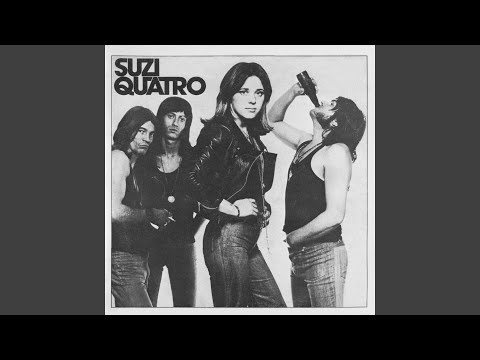
In the United States, however, the story was more complicated. American radio in 1973 was organized around album rock formats on FM and a more conservative mainstream pop orientation on AM. British glam rock, with its theatrical sexuality and compressed pop sensibility, did not translate smoothly to those formats. Quatro's debut album sold modestly in America, and the major hits of her early career simply did not penetrate US radio playlists to any meaningful degree at the time of their original release.
The 1976 US re-release of "Can The Can" coincided with a period when Quatro had achieved some renewed American visibility through her recurring role as Leather Tuscadero on the television series Happy Days, a casting that introduced her to a broad domestic audience. The Chessa Records re-issue entered the Hot 100 on February 7, 1976, debuting at number 66. It climbed to its peak of number 56 the following week and held that position for two weeks before dropping to number 86 and exiting the chart. The four-week run was a modest result that nonetheless represented Quatro's first real US chart showing for a record that had dominated markets worldwide three years earlier.
The chart asymmetry is a striking historical artifact. "Can The Can" remains one of the definitive British glam rock recordings, a song taught in music history courses and cited by countless female rock musicians as an influence. Its US chart position does not begin to reflect its cultural significance or commercial magnitude in the markets where it was originally released. Quatro's career offers a sustained case study in how American pop market structures of the 1970s frequently failed to accommodate sounds that were thriving everywhere else, and "Can The Can" is perhaps the most pointed single illustration of that failure.
By the time Quatro finally did achieve sustained American chart success in 1979 with "Stumblin' In," a duet with Chris Norman, "Can The Can" was already a classic on virtually every other continent. Its 1976 US moment was, in retrospect, a brief late echo of a cultural earthquake that had reshaped pop music internationally years before.
02 Song Meaning
The Meaning and Subtext of "Can The Can"
"Can The Can" presents a surface-level playfulness that obscures a more pointed message about gender dynamics and social expectation. The song, written by Nicky Chinn and Mike Chapman for Suzi Quatro, uses its title as a deliberate double meaning: "can" as a noun (a container) and "can" as a verb (to suppress or confine). The directive buried in the hook instructs a woman to control a man before he strays, offering what amounts to a sardonic guide to romantic possession framed in the breathless vocabulary of glam rock pop.
On one level, the song engages with the familiar pop tradition of the assertive woman addressing romantic competition. Quatro's narrator speaks directly to another woman, issuing instructions about how to keep a desirable but unreliable man in line. There is a knowing edge to the counsel, a suggestion that romantic relationships require vigilance and strategy rather than passive hope. This framing was not entirely new to pop music, but the delivery was exceptional in its intensity and the identity of the artist made the message land differently than it would have from a more conventionally positioned performer.
The significance of who was delivering the message mattered enormously. Suzi Quatro was not a pop confection marketed primarily on appearance. She played bass, led her band, and projected physical authority on stage in a manner that was genuinely atypical for female artists in 1973. When she gave instructions about how a woman should conduct herself in a relationship, the advice carried a kind of credibility that came from presentation rather than content. She was not performing vulnerability; she was performing competence. That distinction shaped how audiences received the song's underlying message.
The glam rock context adds another interpretive layer. Glam was a genre defined by ambiguous sexuality, theatrical excess, and a deliberate blurring of conventional gender roles. Male performers in the genre regularly adopted feminine costuming and presentation as artistic statements. Quatro's intervention in this space was to flip the dynamic: a woman adopting traditionally masculine rock authority while delivering commentary on heterosexual romantic dynamics. The song thus operated simultaneously within and against the genre's conventions, absorbing glam's theatrical energy while redirecting it through a perspective the genre itself rarely centered.
The almost militaristic drive of the production reinforces the song's commanding tone. The instrumentation is insistent to the point of being coercive, suggesting that the advice being dispensed is not optional. The sonic environment created by Chinn and Chapman around Quatro's vocal is one of controlled aggression, a sonic correlate for the song's emotional content. There is no sentimentality in the arrangement, no softening of the edges. The result is a piece of pop music that functions simultaneously as entertainment and as a kind of confident instruction manual delivered by someone who appears entirely certain of her authority.
Quatro herself has spoken about the importance of projecting strength and self-determination in her music and performance choices. "Can The Can" aligned with that aesthetic philosophy: it was a song that refused passivity. The narrator of the song does not lament or question; she directs and advises from a position of confidence. This made the record an early touchstone for discussions about female agency in rock music, even if the critical vocabulary to articulate those discussions was still developing at the time of its release.
Across decades of retrospective critical attention, "Can The Can" has been identified as a significant antecedent in the history of women in rock. Its influence on artists from Joan Jett to various generations of punk and post-punk female performers has been noted repeatedly. The song demonstrated that female rock authority could be commercially viable at the highest levels of the pop market, charting number one in the UK while making no stylistic concessions toward softness or conventional femininity. Its meaning, then, extended beyond its literal narrative to encompass what its very existence demonstrated about who could occupy the center of rock music and on what terms.
→ More from Suzi Quatro
View all Suzi Quatro hits →


→ More from the 1970s File
View all 1970s hits →




Keep digging