The 1970s File Feature
The Golden Age Of Rock 'n' Roll
Mott The Hoople and "The Golden Age Of Rock 'n' Roll": A Glam Rock Statement at the Edge of the Charts By the spring of 1974, Mott The Hoople had established…
01 The Story
Mott The Hoople and "The Golden Age Of Rock 'n' Roll": A Glam Rock Statement at the Edge of the Charts
By the spring of 1974, Mott The Hoople had established themselves as one of the central acts in the British glam rock movement, a band whose combination of hard rock power, intelligent songwriting, and theatrical presentation had earned them a devoted following on both sides of the Atlantic. "The Golden Age Of Rock 'n' Roll" appeared that year as a declaration of the band's self-consciousness about the tradition they inhabited, a song that named and celebrated the era of rock and roll history while staking a claim to be worthy of it. In the United Kingdom the single performed substantially better than in the United States, but its brief American chart appearance, debuting and peaking at number 96 during the week of June 8 before slipping to 100 the following week, placed it in the Hot 100 record as a footnote to the band's more successful American singles.
Ian Hunter, the band's leader, principal songwriter, and most distinctive voice, had by 1974 developed a songwriting style that was simultaneously rock-historical and personally expressive. His lyrics engaged with the mythology of rock and roll while avoiding the trap of mere nostalgia, finding in the music's history a set of values and energies that he genuinely believed in rather than simply referenced for ironic effect. "The Golden Age Of Rock 'n' Roll" represented this sensibility at its most explicit, a song that positioned rock and roll as a civilization with a golden age worth commemorating.
The track was produced by Mick Ronson, the guitarist who had served as David Bowie's principal musical collaborator on the Ziggy Stardust albums before joining Mott The Hoople as both guitarist and producer in 1974. Ronson's production approach brought the sonic signatures of glam rock, those driving rhythms, layered guitars, and theatrical presentation, to bear on Hunter's songwriting in ways that elevated the material without obscuring its essential character. The combination of Hunter's vision and Ronson's craft produced a record that sounded both of its moment and historically aware.
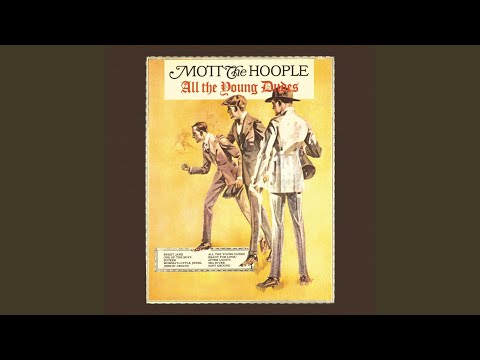
The album from which the single was drawn, The Hoople, was recorded during a period of considerable internal tension within the band. Original lead guitarist Mick Ralphs had departed to form Bad Company, and the lineup changes that followed affected the group's internal dynamics even as their commercial profile remained high. Ronson's arrival was intended partly to stabilize the recording process and partly to provide the guitar leadership that Ralphs's departure had left vacant. In these respects the arrangement was successful: The Hoople was a coherent and accomplished record that demonstrated the band's continued creative vitality.
The song's UK reception was considerably warmer than its American chart performance suggested. British rock audiences had a longer and more personal relationship with Mott The Hoople, whose status on the UK circuit had been cemented by years of touring and by the band's association with David Bowie, who had famously given them "All The Young Dudes" when they were on the verge of breaking up in 1972. "The Golden Age Of Rock 'n' Roll" reached the top ten in the United Kingdom, confirming that the band's domestic standing remained strong even as their American chart position declined.
The American market presented particular challenges for glam rock acts in 1974. While artists like David Bowie and T. Rex had achieved American commercial success, the glam aesthetic was always somewhat at odds with American rock radio's prevailing preferences for harder, less theatrically oriented music. Mott The Hoople's harder rock element gave them more American crossover potential than most glam acts, but they were still working against the grain of formats that preferred the straightforward to the theatrical, the earnest to the self-conscious.
Mott The Hoople's critical legacy has grown considerably in the decades since the band's 1974 breakup, with rock writers and historians coming to recognize their importance as a bridge between the art rock of the late 1960s and the punk movement that followed. Hunter's songwriting, particularly on "All The Young Dudes" and "All The Way From Memphis," is now understood as a formative influence on an entire generation of British musicians who formed punk and new wave bands in the mid-to-late 1970s. "The Golden Age Of Rock 'n' Roll" participates in this legacy as evidence of the band's self-awareness about their own position in rock history.
The brief Hot 100 appearance of "The Golden Age Of Rock 'n' Roll" in June 1974 captures a moment when the band was simultaneously at a peak of artistic self-confidence and beginning to experience the commercial and personal pressures that would lead to their dissolution later that year. The song's title turned out to be elegiac as well as celebratory: the golden age it commemorated was coming to an end even as the band released the record, and the breakup that followed before 1974 was out gave the song an unintended poignancy. For American listeners who caught it in its two-week chart window, it remains a rare document of one of British rock's most distinctive and underappreciated bands working at the peak of their powers.
02 Song Meaning
The Meaning of "The Golden Age Of Rock 'n' Roll" by Mott The Hoople
"The Golden Age Of Rock 'n' Roll" by Mott The Hoople is one of the most overtly self-referential songs in the glam rock canon, a recording that takes rock and roll itself as its subject and argues for the significance of the tradition even as it participates in that tradition. The meaning of the song operates on a meta-level that was relatively unusual in early-1970s rock: rather than using rock music's conventions to communicate something else, the song makes the conventions themselves the content, celebrating the form at the same moment as it employs the form.
Ian Hunter's concept of a "golden age" of rock and roll drew on a periodization of rock history that was becoming standard by 1974. The original explosion of rock and roll in the mid-to-late 1950s, centered on figures like Chuck Berry, Little Richard, Buddy Holly, and Elvis Presley, had acquired the status of a mythological founding moment by the time Mott The Hoople were recording. Subsequent developments, including the British Invasion, psychedelia, and glam rock, were understood as building on and transforming this foundational energy rather than replacing it.
The phrase "golden age" imports from classical historiography the idea that certain historical periods represent high-water marks of achievement, followed by inevitable decline. To invoke this concept in the context of rock and roll was to make a claim about the music's historical significance: that it was worthy of the kind of periodization usually reserved for classical civilizations or canonical artistic movements. This was a serious claim, and Hunter made it seriously rather than ironically, with the conviction of someone who genuinely believed in rock and roll as a civilization with genuine values and genuine achievements.
The song also functions as a statement about Mott The Hoople's own identity and aspirations. By aligning themselves with the golden age of rock and roll, Hunter and his bandmates were claiming membership in a tradition rather than merely commercial success in a marketplace. This was a distinction that mattered enormously to rock culture in the early 1970s, when the question of authenticity, of whether an artist was genuinely of the rock and roll tradition or merely exploiting its commercial possibilities, was a central preoccupation of critics, fans, and artists alike.
The glam rock context in which the song was created adds another layer of meaning. Glam rock was itself engaged in a complex relationship with the rock and roll tradition, simultaneously celebrating and theatricalizing it, using costume, makeup, and performance art to both honor and estrange the conventions of the form. Hunter's more earnest relationship to the tradition set him somewhat apart from the more playfully ironic glam acts, and "The Golden Age Of Rock 'n' Roll" reflects this distinction: it is a song that means what it says rather than ironizing what it says.
The timing of the song's release gave it an unplanned additional meaning. Mott The Hoople broke up in 1974, shortly after the song appeared, making "The Golden Age Of Rock 'n' Roll" inadvertently elegiac for their own career as well as for the broader tradition it celebrated. The golden age it commemorated turned out to include the band's own work, and the dissolution of the group gave the song's title a personal resonance that its author could not have anticipated when he wrote it.
For subsequent generations of rock fans, particularly those who came to Mott The Hoople through their influence on punk and new wave artists, the song carries the meaning of a crossroads: a moment when one of rock and roll's most intelligent practitioners looked backward at the tradition's achievements while standing at the threshold of the tradition's most radical transformation. The golden age it celebrated was ending, and a new and very different era was about to begin.
→ More from Mott The Hoople
View all Mott The Hoople hits →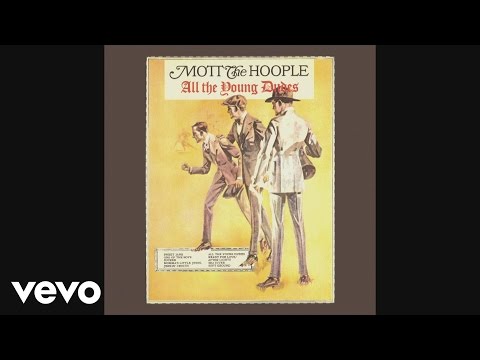
→ More from the 1970s File
View all 1970s hits →




Keep digging