The 1970s File Feature
You Always Come Back (To Hurting Me)
Johnny Rodriguez and the Country Crossover: "You Always Come Back (To Hurting Me)" (1973) In the summer of 1973, Johnny Rodriguez was one of the most compell…
01 The Story
Johnny Rodriguez and the Country Crossover: "You Always Come Back (To Hurting Me)" (1973)
In the summer of 1973, Johnny Rodriguez was one of the most compelling new voices in American country music, a young Texan of Mexican descent who had arrived on the Nashville scene with a combination of natural vocal gifts and a backstory that seemed almost too dramatic to be real. Born Juan Raul Davis Rodriguez in Sabinal, Texas, in December 1951, he had grown up in a large family of modest means, learned to play guitar as a child, and spent time in jail for goat theft as a teenager, an incident that paradoxically launched his professional career when a Texas Ranger named Happy Shahan took notice of his singing and introduced him to talent scouts.
Rodriguez's path to Nashville had led through the band of Tom T. Hall, the celebrated country songwriter and performer who provided the young singer with his first significant professional exposure. Hall recognized in Rodriguez a vocal talent of unusual quality, combining a natural warmth of tone with a technical control that allowed him to move between the direct emotional statement and the more ornamental traditions of Mexican-influenced vocal music. This cultural background gave Rodriguez a distinctiveness that set him apart from the mainstream Nashville sound of the early 1970s, and producers and record executives who heard him understood that they were in the presence of something genuinely uncommon.
His debut single, "Pass Me By (If You're Only Passing Through)," released in 1972, had reached number nine on the Billboard country chart and announced him as a major new presence in the format. Subsequent releases had confirmed and extended the promise of that debut, establishing a pattern of commercial success on the country chart that would continue throughout the decade. "You Always Come Back (To Hurting Me)" was part of this early productive period, appearing on the Hot 100 in the summer of 1973 as Rodriguez's crossover potential attracted attention beyond the strictly country market.
The single debuted on the Billboard Hot 100 on June 23, 1973, entering at the chart's floor position of number 100. Its climb was modest but deliberate: the song moved to number 99 in its second week, reached number 87 in the third week, and achieved its peak of number 86 on July 14, 1973, spending four weeks on the chart in total. This performance reflected the partial nature of the crossover: Rodriguez was attracting pop listeners who had encountered him through country radio or through the broader cultural machinery of early 1970s country's mainstream moment, but his primary commercial strength remained within the country format.
The song itself was produced with the production values of Nashville's country-pop mainstream, which in 1973 was navigating its own internal debates about how fully to embrace the lush orchestral arrangements associated with the "countrypolitan" style developed by producers like Chet Atkins and Owen Bradley in the previous decade. The production gave Rodriguez's voice ample space while providing a sympathetic musical environment that reinforced the song's emotional content without overwhelming the vocal performance.
Rodriguez's emergence as a star coincided with a moment of significant cultural negotiation around the place of Latino artists within the Nashville establishment. Country music had always had its complicated relationships with cultural identity, and Rodriguez's success raised questions about whether his crossover appeal was partly attributable to his appearance and biography rather than solely to his music. The critical consensus, then and subsequently, has been that his vocal abilities were sufficient to earn commercial success on their own terms, and that questions of ethnic identity, while relevant to understanding his historical position, do not diminish the genuine quality of his artistry.
The album from which the single was drawn, released on Mercury Records, showcased the range of Rodriguez's abilities across a set of material that balanced original compositions with carefully selected covers. Billy Sherrill, one of Nashville's most accomplished producers, worked with Rodriguez on recordings that positioned him to succeed on both the country and pop formats without sacrificing the stylistic integrity that made him distinctive. This balancing act was characteristic of Nashville crossover strategies of the period and required both the artist and the producer to make careful choices about how much musical adaptation was compatible with maintaining authentic identity.
Rodriguez continued to record prolifically through the 1970s and beyond, accumulating a substantial body of work that confirmed his status as one of the most significant country artists of his generation. His early Hot 100 appearances, including "You Always Come Back (To Hurting Me)," represent the moment when the broader American pop audience was first becoming aware of a talent that country audiences had already recognized as exceptional.
02 Song Meaning
The Cycle of Return: The Meaning of "You Always Come Back (To Hurting Me)"
"You Always Come Back (To Hurting Me)" by Johnny Rodriguez engages with one of the oldest subjects in country music: the relationship that cannot end, the romantic entanglement in which the parties return to each other despite the damage each return inevitably causes. This subject has occupied country songwriters since the genre's earliest commercial recordings, because it touches something essential about human emotional experience that is simultaneously universally recognizable and intensely personal.
The song's title encodes its central paradox with unusual economy. To come back is normally a positive event; in romantic narrative, the return of the absent lover is conventionally celebrated. But here the return is immediately qualified by the parenthetical that follows it: the coming back is inseparable from the hurting, and the inevitability of the return is also the inevitability of renewed pain. The grammatical structure of the title performs the song's emotional logic: what seems on first reading like a declaration of affection reveals itself on second reading as a statement of damage.
Rodriguez's vocal delivery was particularly well-suited to this kind of emotionally complex material. His voice carried a quality of vulnerability combined with resilience, the sound of someone who has been hurt before and knows he will be hurt again but continues to feel rather than to protect himself from feeling. This combination of openness and wounded experience is central to the best country vocal performances, and Rodriguez had developed it to a high degree of sophistication despite his youth at the time of the recording.
The specific pain addressed in the song is the pain of hope repeatedly disappointed. The narrator is not describing a single wound but a pattern, a cycle of separation and reunion in which each reunion carries the knowledge of the previous departures. Country music has always been particularly attentive to this kind of temporal complexity, to the way in which the present moment in a long relationship is shaped by the accumulated weight of all previous moments. The song's title, with its present tense "you always come back," suggests that the cycle is ongoing rather than concluded, that the narrator is describing his current situation rather than a past one he has resolved.
This ongoing quality gives the song a different emotional register from the "lost love" tradition, in which the narrative is told retrospectively from a position of separation. Rodriguez's narrator is in the middle of the story rather than at its end, and this proximity to the experience gives the emotional content an immediacy that retrospective narration often lacks. The listener does not feel that the pain has been processed and resolved but rather that it is live and present, which is a more demanding emotional position for a song to occupy and, when executed successfully, a more moving one.
The country crossover context of the song's Hot 100 appearance added another dimension to its meaning. For pop listeners encountering Rodriguez's voice for the first time through the single's limited crossover chart performance, the song introduced a set of emotional and musical conventions that were somewhat different from those governing mainstream pop of 1973. Country music's willingness to sit with pain without resolving it, to describe suffering without offering consolation or escape, was a quality that some pop listeners found deeply appealing precisely because it differed from the more redemptive emotional arc that pop narratives typically followed.
Rodriguez brought to this material a cultural specificity that enriched its generic conventions. His Texas-Mexican background gave his voice particular qualities of tone and expression, and his evident sincerity in delivering emotionally direct material connected to a tradition of vocal performance that valued authenticity above technical display. The result was a song that worked simultaneously as a country record, a pop crossover, and a vehicle for a distinctive artistic personality whose full significance would become clearer as his career extended through the decade.
→ More from Johnny Rodriguez
View all Johnny Rodriguez hits →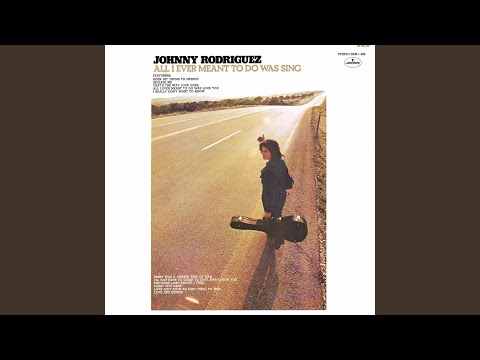

→ More from the 1970s File
View all 1970s hits →




Keep digging