The 1970s File Feature
Since I Met You Baby
Since I Met You Baby: Freddy Fender and the Revival of a Classic "Since I Met You Baby" had been a recognized standard long before Freddy Fender brought it t…
01 The Story
Since I Met You Baby: Freddy Fender and the Revival of a Classic
"Since I Met You Baby" had been a recognized standard long before Freddy Fender brought it to a new generation of listeners in 1975. The song was written and originally recorded by Ivory Joe Hunter, the Texas-born blues and R&B pianist whose 1956 version had become one of the defining recordings of the early rhythm-and-blues era, reaching number twelve on the pop charts and number one on the R&B charts and demonstrating Hunter's gift for the meeting point of blues, pop, and early rock and roll. Fender's recording, released on ABC/Dot Records, appeared during a period when the Tex-Mex singer from San Benito, Texas was at the height of his unexpected commercial breakthrough, and it added another chapter to a song that had already proven its staying power across two decades.
Freddy Fender's emergence as a mainstream pop and country success story in 1975 was one of the more unlikely developments in American popular music. Born Baldemar Garza Huerta, Fender had spent the preceding decades as a regional figure on the Texas music scene, recording in a style that blended conjunto, rock and roll, and country in ways that reflected the cultural environment of the Texas-Mexico border region. His career had been severely interrupted by a drug conviction in 1960 that resulted in a prison sentence and effectively removed him from professional music for several years. He had continued performing after his release but remained far outside the commercial mainstream until the early 1970s, when producer Huey Meaux brought him into a studio in Louisiana and the resulting recordings changed everything.
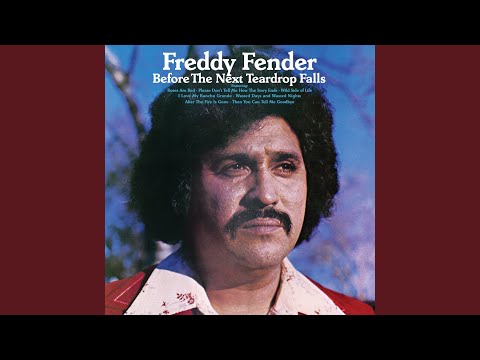
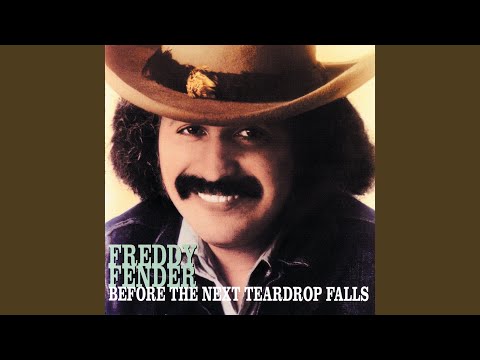
The recording that launched Fender's commercial breakthrough was "Before the Next Teardrop Falls," which reached number one on the Billboard Hot 100 in 1975 and made him one of the most improbable commercial success stories of the year. Its follow-up, "Wasted Days and Wasted Nights," also performed well, and "Since I Met You Baby" arrived as part of the same commercial momentum, demonstrating that Fender's audience was large and loyal enough to sustain continued chart success.
Fender's version reached the top twenty of the Billboard Hot 100 and also performed strongly on the country charts, confirming the genuinely crossover nature of his appeal. His voice was one of the more distinctive in contemporary pop: a warm, slightly rough-edged baritone with a natural emotional directness that owed something to the blues tradition and something to the country ballad tradition and something to the conjunto music of his upbringing, all of it filtered through the particular sound of the Texas-Mexico border region. This distinctiveness gave his recordings an identity that set them apart from the more polished country and pop productions that surrounded them in the charts.
The production of the Fender recordings during this period bore the unmistakable imprint of producer Huey Meaux, whose approach combined the spare, direct production values of country music with the rhythmic sensibility of R&B and a sound that reflected the cultural geography of the Gulf Coast. "Since I Met You Baby" received the kind of treatment that suited the song's fundamental simplicity, allowing Fender's voice to carry the recording without excessive ornamentation, trusting the song's emotional directness and the singer's ability to communicate it.
The choice to record Ivory Joe Hunter's composition was apt in multiple respects. Hunter had been one of the artists who bridged the divide between R&B and mainstream pop in the 1950s, working in a style that was simultaneously rooted in Black musical tradition and accessible to the broad pop audience. Fender was himself an artist who bridged multiple musical worlds, and his connection to the song's emotional material was genuine. The original recording had been an expression of transformative romantic feeling, of a love that had fundamentally changed the narrator's life and perspective, and Fender's own life story, with its interruptions and reversals and unlikely second acts, gave him a particular credibility when singing about transformation and new beginnings.
The song appeared during a period when mainstream country radio was showing unprecedented openness to artists whose backgrounds did not fit the Nashville template, and Fender's Mexican-American heritage and Texas roots were part of what made him interesting to a country audience that was itself growing more diverse in its tastes. His success helped establish that country music's commercial base could accommodate voices and perspectives that had historically been excluded from the genre's mainstream, a development that would have lasting consequences for the genre's evolution.
Retrospectively, the recordings Fender made during his commercial peak in the mid-1970s, including "Since I Met You Baby," stand as important documents of a particular moment in American popular music when the walls between country, pop, R&B, and regional styles were more permeable than they had been before or would be again. Fender's Grammy Award for Best Male Country Vocal Performance in 1975 for "Before the Next Teardrop Falls" situated him within the country mainstream even as his musical roots lay elsewhere, reflecting the industry's recognition of a genuinely unusual talent.
02 Song Meaning
Love as Transformation: What "Since I Met You Baby" Expresses
"Since I Met You Baby" is a song about the before and after of love, about the experience of a single relationship dividing a life into two distinct periods: the one that preceded it and the one that came after. The Ivory Joe Hunter composition, as interpreted by Freddy Fender, presents love not as a pleasant addition to an already comfortable life but as a fundamental reorganization of the narrator's inner landscape, a force that has changed not just his circumstances but his way of experiencing the world.
This theme of transformative love was well suited to Fender's particular artistic identity. His own life had contained dramatic transformations, periods of creative suppression and unexpected renewal, and his voice carried in it the experience of someone who understood how thoroughly circumstances could change a person's life trajectory. When Fender sang about a love that had changed everything, the emotional credibility was not simply a function of his performing skill but of the accumulated experience that his voice expressed whether he intended it to or not.
The song belongs to a tradition within R&B and country of recordings that try to capture the particular quality of a love that feels definitive, a relationship that arrives and makes all previous experience seem like preparation. Ivory Joe Hunter had understood this territory deeply, having built a career on the border between country sentiment and R&B expressiveness, and his composition embodied both traditions' approach to the subject: the country emphasis on plainspoken emotional declaration and the R&B emphasis on physical and emotional immediacy. Fender's performance honored both traditions without forcing a choice between them.
The emotional register of Fender's recording was warm and grateful rather than urgent or desperate. The narrator was not pining for someone or trying to win them back; he was reflecting on a love that had arrived and settled into something permanent, and the feeling the song conveyed was one of quiet thankfulness. This gratitude, expressed through Fender's relaxed but emotionally present delivery, gave the recording a quality of contentment that was somewhat unusual in popular music's treatment of romantic subjects, which more commonly focused on desire, loss, or conflict rather than on the peaceful satisfaction of a love that had taken root and flourished.
In the context of the mid-1970s, when so much of popular music's emotional content was colored by disillusionment and uncertainty, the simple, sincere romanticism of "Since I Met You Baby" offered audiences something they clearly wanted: an uncomplicated celebration of love's transformative power, delivered by an artist whose own story gave the sentiment a weight that purely commercial calculation could not have produced. Fender was not performing happiness about love; he was communicating an experience of it that his listeners recognized as genuine, and that recognition was the foundation of his brief but significant commercial success. The song endures as one of the most honest and affecting expressions of that experience in his catalog.
→ More from Freddy Fender
View all Freddy Fender hits →

→ More from the 1970s File
View all 1970s hits →




Keep digging