The 1960s File Feature
Shapes Of Things
Shapes Of Things: The Yardbirds Lunge Toward Psychedelia in 1966 By the time "Shapes of Things" was released on Epic Records in February 1966 , the Yardbirds…
01 The Story
Shapes Of Things: The Yardbirds Lunge Toward Psychedelia in 1966
By the time "Shapes of Things" was released on Epic Records in February 1966, the Yardbirds were already a band in creative turbulence. They had built their reputation on a raw, propulsive brand of British R&B, launching the careers of Eric Clapton and then Jeff Beck in quick succession as lead guitarists. It was Beck who played on "Shapes of Things," and the recording stands as one of the most audacious single releases the British Invasion era produced, a track that pointed directly toward psychedelic rock and heavy metal a full year before either genre had been named.
The song was written by the band's rhythm guitarist Chris Dreja together with bassist Paul Samwell-Smith and vocalist Keith Relf. The three had been developing a more experimental direction for months, growing restless with the competent but comparatively straightforward pop-R&B framework that had delivered their previous hits. Relf's lyrical framework contemplated the relationship between humanity and nature, the dangers of industrial civilization, and the sensation of standing at the edge of something enormous and unknowable. The words were unusual for a British pop single in 1966, carrying genuine philosophical weight at a moment when most chart-bound material stuck to romantic subjects.
What truly set the recording apart was Jeff Beck's guitar work. Beck had joined the Yardbirds in March 1965 after Clapton's departure, and within months he had begun pushing the instrument into territory it had rarely visited. On "Shapes of Things," he deployed controlled feedback, unusual sustain techniques, and a solo passage that effectively abandoned conventional melodic phrasing in favor of noise and texture. The solo was shocking in context, a jagged, sustained shriek of sound that felt more like avant-garde experimentation than anything designed for BBC radio play. It was a direct ancestor of what Jimi Hendrix would do in 1967, and of the feedback explorations that Jimmy Page, soon to join the Yardbirds himself, would develop through the rest of the decade.
Producer Simon Napier-Bell, who had taken over management and production duties for the band, allowed Beck considerable latitude in the studio. The arrangement strips away excess ornamentation in favor of a clean, slightly ominous groove that lets the guitar's eccentricities register with full impact. Keith Relf's vocal delivery is restrained and slightly detached, which suits the song's meditative subject matter. There is none of the whooping, crowd-pleasing energy of earlier Yardbirds work; the mood is reflective and at moments deeply unsettled.
The single reached number three on the UK Singles Chart, a strong commercial performance for a record that took so many risks. In the United States, where the Yardbirds had been building an audience through appearances on television programs and a series of well-received tours, the song climbed to number eleven on the Billboard Hot 100, making it one of their most successful American chart entries. That level of success for material this experimental demonstrated that at least a segment of the pop audience in 1966 was genuinely ready for something more demanding.
The record arrived at a pivotal moment in British rock. The Beatles were months away from releasing "Revolver," the album that would legitimize the idea of psychedelic experimentation within mainstream pop. The Rolling Stones were beginning to incorporate stranger textures into their work. But the Yardbirds, on this particular single, moved faster than almost anyone. "Shapes of Things" is sometimes cited by music historians as one of the first psychedelic rock recordings to achieve significant chart success on both sides of the Atlantic.
Within months of the single's release, internal tensions within the Yardbirds began to boil over. Paul Samwell-Smith quit the band shortly after the recording, and Jimmy Page was brought in first as a bassist and then as a second guitarist alongside Beck. The Beck-Page lineup lasted only a handful of months before Beck departed as well, leaving Page to reconstitute the group before eventually dissolving it entirely and founding Led Zeppelin in 1968. The history of "Shapes of Things," then, is the history of a band at its creative peak and simultaneously at the beginning of its dissolution.
The song was collected on several Yardbirds compilations over the decades, and its influence on the development of hard rock, heavy metal, and psychedelic music has been acknowledged repeatedly by later artists and by music critics. Beck himself identified this period of his work with the Yardbirds as foundational to everything he developed as a solo artist afterward. In 2004, Rolling Stone magazine ranked "Shapes of Things" among the greatest guitar performances in rock history, a recognition of just how forward-looking Beck's work on the track had been. The recording remains one of the most important two and a half minutes the British Invasion produced.
02 Song Meaning
Shapes Of Things: Ecology, Anxiety, and the Sound of the Future
"Shapes of Things" is notable among British Invasion singles for the seriousness of its thematic ambitions. Where the vast majority of chart music in 1966 concerned itself with romantic pursuit, heartbreak, or the pleasures of youth, this song turned its attention toward the relationship between human civilization and the natural world. The narrator surveys a landscape and reflects on how industrial and social forces are reshaping the earth, not always for the better. There is a quality of unease running through the entire song, a sense that something irreplaceable is being lost or damaged even as modernity announces itself as progress.
The lyrics, written collectively by Chris Dreja, Paul Samwell-Smith, and Keith Relf, do not function as protest in any direct, slogan-bearing sense. They are more meditative than that, closer to a visual poem than a manifesto. The narrator seems to stand at a vantage point from which he can see both beauty and destruction simultaneously, and the emotional register is one of sorrow rather than anger. This tonal choice makes the song more durable than material that might have expressed similar concerns through righteous fury. The sadness feels earned rather than performed.
Jeff Beck's guitar solo is itself a statement about dissolution and disruption, functioning almost as a sonic illustration of the themes in Relf's words. The solo does not resolve or reassure. It escalates and fragments, moving away from melody into pure textural expression before the song pulls back toward its structure. In this sense the arrangement enacts what the lyrics describe: an ordered world giving way to something more chaotic and uncertain. This is remarkably sophisticated musical storytelling for a pop single produced for the commercial British market in early 1966.
The song also carries an existential dimension that goes beyond environmental anxiety. The narrator's reflections extend to questions about perception, time, and the limits of human understanding. There is a sense that the shapes being contemplated are not only literal landscapes but also the outlines of ideas, futures, and possibilities that the mind can partially glimpse but never fully grasp. This philosophical register aligns the song with the emerging counterculture's interest in expanded consciousness and alternative ways of understanding reality, even though those themes were more commonly associated with 1967 and later.
For the Yardbirds as artists, the song represented a deliberate expansion of what they were willing to attempt. They had always been a technically proficient band with real blues credibility, but "Shapes of Things" pushed beyond craft into genuine artistic risk-taking. Keith Relf, as vocalist, delivered the unusual lyrics without condescension or self-consciousness, treating the material with the same directness he would have brought to a straightforward R&B number. That commitment gave the record its authority.
The song's legacy within the Yardbirds' catalog is substantial: it is consistently cited as the moment when the band fully transcended its British R&B origins and became something genuinely original. For Beck, it was among the first clear demonstrations of a guitar vocabulary that would define his entire solo career. The willingness to use noise, feedback, and unresolved tension as expressive tools rather than problems to be corrected set him apart from virtually every other electric guitarist of his generation. "Shapes of Things" showed that the electric guitar could be an instrument of philosophical inquiry as much as an instrument of entertainment, a proposition that rock music would spend the next decade exploring.
→ More from The Yardbirds
View all The Yardbirds hits →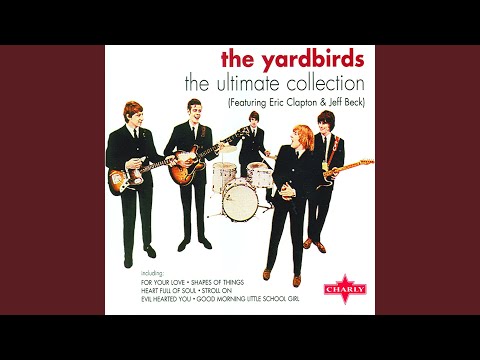
→ More from the 1960s File
View all 1960s hits →




Keep digging