The 1960s File Feature
She's A Rainbow
"She's a Rainbow" — The Rolling Stones The Stones in Their Psychedelic Year The summer of 1967 was one of the most extraordinary seasons in rock and roll his…
01 The Story
"She's a Rainbow" — The Rolling Stones
The Stones in Their Psychedelic Year
The summer of 1967 was one of the most extraordinary seasons in rock and roll history. Sgt. Pepper's Lonely Hearts Club Band had arrived in June, and with it the sense that popular music had crossed into a new territory, more ambitious, more experimental, more willing to take itself seriously as an art form. Every major rock act found itself responding to that moment, consciously or not. The Rolling Stones, who had built their reputation on a leaner, meaner version of British rhythm and blues, were in the middle of their own psychedelic experiment, which produced their most sonically adventurous album to that point.
Their Satanic Majesties Request, released in December 1967, was the Rolling Stones' most direct engagement with the psychedelic aesthetic that had come to define the era. It was received with considerable ambivalence at the time, with critics who preferred the Stones' rougher-edged work viewing the orchestral and experimental elements as a concession to a trend rather than a genuine artistic evolution. History has been kinder to the album, and "She's a Rainbow" has emerged as one of its most beloved tracks.
The Creation of Something Colorful
Written by Mick Jagger and Keith Richards, "She's a Rainbow" is distinctive within the Stones' catalog for its genuinely delicate quality. The track opens with a piano figure, played by Nicky Hopkins, that is immediately arresting in its ornate sweetness, a character completely at odds with the band's usual approach. Nicky Hopkins's piano playing on "She's a Rainbow" is the track's defining instrumental element, establishing the song's watercolor aesthetic from its opening bars. Hopkins, one of the great session pianists of the rock era, contributed to recordings by virtually every major British rock act of the 1960s and 1970s, and his work here is among his most immediately recognizable.
The orchestral arrangement was contributed by John Paul Jones, the bassist who would go on to found Led Zeppelin with Jimmy Page the following year. In 1967, Jones was among London's most in-demand arrangers for rock sessions, and his string writing for "She's a Rainbow" provided the track with its lush, swelling quality that matched the song's fantastical lyrical premise. The combination of Hopkins's piano, the Stones' rhythm section, and Jones's orchestration created a sound unlike anything else in the band's catalog.
The Chart Run Into 1968
The single entered the Billboard Hot 100 on December 30, 1967, debuting at number 77. Over the following weeks it climbed: 48 on January 6, then 36, then 30, reaching its peak of 25 on January 27, 1968, where it spent one week before beginning its descent. Seven weeks total on the chart was a solid run for a Rolling Stones release, though the track landed well below the band's biggest American hits of the period. The psychedelic Satanic Majesties material never achieved the commercial heights of the hard-edged singles that flanked this album era.
The timing of the chart run, straddling the year end of 1967 and the first month of 1968, placed it at a particular hinge point in popular music history, just as the Summer of Love's euphoria was beginning to give way to something more complicated.
A Departure That Became a Classic
Within the Stones' catalog, "She's a Rainbow" occupies an unusual and cherished position. It is the band in a mode they rarely attempted, gentle, ornate, romantic in a way that their better-known work deliberately avoided. The track's embrace of softness and color, in both its lyrical imagery and its musical palette, stands as a fascinating counterpoint to the swagger and menace that defined the band's core identity. The song's appearance in countless films, commercials, and television programs over the decades since its release confirms that its appeal extends well beyond Stones fans, reaching listeners who might not connect with "Jumpin' Jack Flash" or "Sympathy for the Devil."
Heard Across the Decades
The staying power of "She's a Rainbow" is one of those minor mysteries of pop culture: why does a track from a Stones album that was critically dismissed at release remain so persistently beloved? The answer may simply be that a beautiful, well-crafted song survives the fashions that surrounded its creation. Nicky Hopkins's piano, John Paul Jones's strings, and a melody that lodges effortlessly in the listener's memory constitute a combination that requires no critical vindication. Press play and you are immediately inside one of 1967's most luminous recordings.
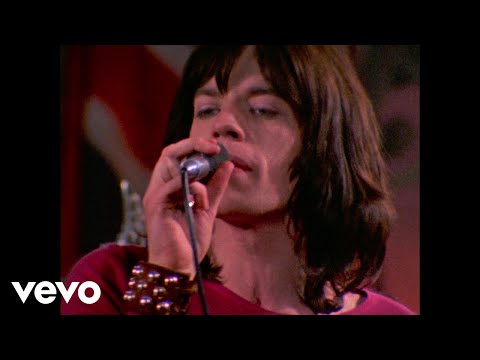
"She's a Rainbow" — The Rolling Stones' singular moment on the 1960s charts.
02 Song Meaning
"She's a Rainbow" — Color, Femininity, and Psychedelic Idealism
A Portrait Painted in Primary Colors
The lyrical premise of "She's a Rainbow" is as simple and as poetic as the title suggests: a woman described entirely through the metaphor of color. Each verse elaborates this central image, finding in the subject's appearance and presence a kaleidoscopic quality that the narrator can only name through chromatic language. This is psychedelic poetry in its most accessible form, rooted in real sensory experience but reaching toward a kind of visionary intensity that ordinary descriptive language cannot achieve.
The decision to use color as the organizing metaphor connects the song to a broader psychedelic aesthetic that permeated the art, fashion, and music of 1967. The year was saturated with color in a way that had specific cultural meaning: the turn away from the monochromatic sobriety of the early 1960s toward a visual extravagance that expressed the era's rejection of constraint and convention. Describing a woman as a rainbow in 1967 was both a personal romantic declaration and a statement of cultural alignment.
Femininity as Vision in 1967
The song's portrait of its subject is idealized in a way characteristic of the era's artistic sensibility. The woman is beheld rather than known, experienced as a set of visual impressions rather than as a complex interiority. This is a limitation from a contemporary perspective but it is also an accurate reflection of how psychedelic culture often approached the feminine: as a source of beauty and inspiration to be contemplated, a muse rather than a fully realized person. The track belongs to a long tradition in rock and pop of the idealized woman, filtered through the specific visual language of the late 1960s counterculture.
Reading the song charitably, the chromatic celebration of the subject communicates a genuine sense of wonder and attentiveness, the quality of truly noticing another person. The lover in the song sees the woman with an almost hallucinatory clarity, perceiving her as a phenomenon rather than merely a person. Whether this represents depth of feeling or a failure of engagement depends on what one values in a love song.
The Musical Meaning and the Psychedelic Moment
The match between "She's a Rainbow" and the summer of 1967 was near perfect: a song that sounded like what the cultural moment felt like to its most optimistic participants. The warmth of Nicky Hopkins's piano, the swelling strings, the gentle vocal delivery, all combined to create music that made the world feel briefly available, permeable, and beautiful. Psychedelic music at its best created this sensation, the sense that ordinary perception had been expanded to include something transcendent. The song achieved this without recourse to distortion or abstraction, through the more classical means of orchestration and melodic craft.
In the context of the Stones' catalog, which skews considerably darker and more aggressive, the track stands as evidence that the band was capable of a range that their reputation sometimes obscures. The psychedelic year showed a Rolling Stones willing to be vulnerable, ornate, and gentle.
Why It Has Lasted
Songs survive their era when they contain something that transcends the specific cultural moment that produced them. "She's a Rainbow" has proven particularly durable because it distills a feeling that exists independently of 1967's specific context: the experience of seeing another person as a source of wonder, as someone who brightens the visual field simply by being present. This is a universal experience given a specific and beautiful expression, which is the core project of all lasting popular song. Decades of use in films, commercials, and playlists confirm that its appeal outlasted the era that made it.
→ More from The Rolling Stones
View all The Rolling Stones hits →


→ More from the 1960s File
View all 1960s hits →




Keep digging