The 1960s File Feature
Jumpin' Jack Flash
Jumpin' Jack Flash — The Rolling Stones Reclaim Their Fury The Return to Raw Energy Sometime in the spring of 1968, the Rolling Stones walked back from the e…
01 The Story
Jumpin' Jack Flash — The Rolling Stones Reclaim Their Fury
The Return to Raw Energy
Sometime in the spring of 1968, the Rolling Stones walked back from the edge of psychedelia. Their 1967 album Their Satanic Majesties Request had been, by general critical consensus, an overreach into territory better left to the Beatles: elaborate studio constructions, ornate arrangements, and the kind of high-concept ambition that suited neither the band's strengths nor its identity. Jumpin' Jack Flash announced the correction with startling force. Everything about it, the churning rhythm guitar, the snarling Keith Richards riff, Mick Jagger's performance delivered with the coiled energy of someone who had been waiting too long for exactly this, said: the Stones were back where they belonged.
Keith Richards has described the song's genesis as rooted in something genuinely simple: a rhythm, a riff, an image of a farmhand named Jack Dyer who worked on the property where he and Jagger were staying in the English countryside. Whether the biographical details are precise or mythologized, the song carries the feeling of something that arrived whole rather than constructed, a rock track that seems to have always existed, waiting to be discovered.
A Riff That Changed the Conversation
The guitar work that opens the track is among the most recognizable in rock history. Tuned in an open tuning and recorded through a cassette player to achieve that particular buzzing, compressed quality, the main riff by Richards became a standard reference point for rock guitar players in the decades that followed. The technique was not conventionally sophisticated, but it produced a sound that was immediately, viscerally exciting in a way that no amount of technical sophistication could have manufactured.
The rhythm section performance from Charlie Watts and Bill Wyman grounds the track without overcomplicating it. Watts's drumming is characteristically understated and precisely placed; Wyman's bass provides the harmonic foundation that lets the guitar riff breathe above it. Nicky Hopkins contributed piano parts that add texture without cluttering the essential simplicity that gives the track its power.
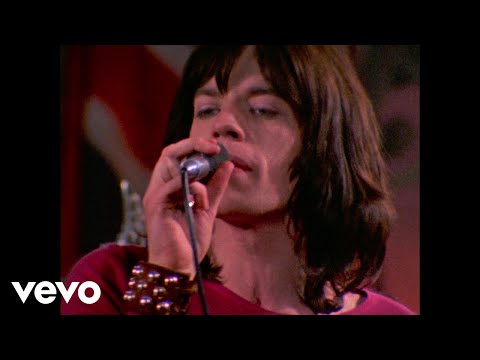
Jagger's vocal performance is one of his finest on record: imperious, self-amused, physically present in the way that separates great rock singing from mere competent singing. The character he inhabits across the lyric, born in a storm, raised in a gutter, surviving through some combination of luck and defiance, is indelible.
The Chart Ascent of Summer 1968
Released in May 1968, Jumpin' Jack Flash debuted on the Billboard Hot 100 on June 8, 1968, entering at position 62. The climb was rapid and convincing: within four weeks the track had ascended to 11, and by the week of July 6, 1968, it reached its peak of number 3. Twelve weeks of chart presence confirmed what radio programmers across America had sensed immediately: this was one of the year's biggest rock singles.
The summer of 1968 was a summer of profound cultural turbulence. The assassinations of Martin Luther King Jr. and Robert Kennedy had shattered the decade's optimism in a matter of months. Student protests convulsed Paris, Chicago, and dozens of other cities. In that atmosphere, a song about resilience delivered as a roaring rock assault carried a resonance beyond its lyrical content.
Legacy and Permanence
In the fifty-plus years since its release, Jumpin' Jack Flash has become one of the songs most reliably associated with the Rolling Stones at their essential best. It has appeared in films, television programs, commercials, and innumerable cover versions across every conceivable genre. The Stones themselves have used it as a set closer for live shows across multiple decades, a song that can still function as a credible concluding statement regardless of what era of the band's career surrounds it.
The track marked a genuine turning point: the moment when the Rolling Stones stopped trying to compete with psychedelia on its own terms and reasserted the blues-rock identity that had always been their most authentic artistic territory. Every great recording they made in the years that followed, Honky Tonk Women, Brown Sugar, Gimme Shelter, traces back in some measure to the decision that produced this track.
Turn the volume up and let that opening riff do its work.
"Jumpin' Jack Flash" — The Rolling Stones' singular moment on the 1960s charts.
02 Song Meaning
Jumpin' Jack Flash — Survival, Reinvention, and Rock's Primal Energy
A Character Born from Hardship
The figure at the center of Jumpin' Jack Flash is one of rock's most vivid characters: a person whose origin story is entirely defined by adversity. Born in circumstances of elemental difficulty, raised without comfort or security, forged into something resilient by conditions that might have destroyed anyone less durable. The narrative does not ask for sympathy; it reports survival as a simple fact and invites the listener to find something worth celebrating in mere continuance.
This mythology of the survivor has deep roots in blues tradition, the music that formed the Rolling Stones' artistic consciousness. Blues lyrics have always dwelt on people who endure despite everything, finding in that endurance a form of dignity that no external circumstance can entirely remove. Jumpin' Jack Flash translates that sensibility into rock idiom without losing the original emotional content.
The Riff as Philosophy
There is a philosophical dimension to great guitar riffs that is easy to overlook when discussing them as sonic events. The riff that opens and drives Jumpin' Jack Flash is not just a clever musical idea; it is a statement about the nature of rock music itself. Raw, physical, immediately communicative, it argues that music does not need to be elaborate or conceptually ambitious to be powerful. Simplicity deployed with absolute conviction produces something that complexity cannot achieve.
In 1968, after two years in which the most celebrated rock music had tended toward studio complexity, psychedelic experimentation, and conceptual sophistication, that argument needed making. The Stones made it definitively, and the response confirmed that a significant portion of the audience had been waiting for exactly this reassertion of the basics.
1968 and the Culture of Defiance
The song arrived in one of the most turbulent years of the twentieth century. The late 1960s' mood oscillated between utopian aspiration and genuine fear, between the belief that everything could change and the evidence that change was violently resisted. A song about surviving impossible circumstances, delivered with total commitment to joy rather than misery, spoke to that cultural moment without explicitly addressing it.
Music that chooses aliveness over despair in a season of despair carries a particular weight. Jumpin' Jack Flash does not propose solutions or offer political analysis; it simply insists, through its sheer sonic force, that vitality is possible. That insistence is itself a form of statement, particularly when delivered by a band whose identity was built around the refusal of false consolation.
Why It Endures
The song has been covered hundreds of times across the decades since its release. Covers by artists as different as Aretha Franklin, Peter Frampton, and Tina Turner all found something in the track that translated across genre contexts, confirming that the essential elements transcend any particular stylistic frame. The survival narrative in the lyric, the rhythmic momentum in the music, and the sheer exhilaration of the performance combine into something that resists the aging that claims most pop singles.
At its peak of number 3 on the Billboard Hot 100, the track demonstrated its commercial reality. Across the decades that followed, its continuous presence in films, sports arenas, classic rock radio, and cultural memory demonstrated something more durable. Few songs so explicitly about difficulty have produced such universal pleasure.
The gas gas gas of the refrain is not incidental wordplay. It is an engine running at full throttle, which is exactly what the song wants to be and what its audience needs it to remain.
"Jumpin' Jack Flash" — The Rolling Stones' singular moment on the 1960s charts.
→ More from The Rolling Stones
View all The Rolling Stones hits →


→ More from the 1960s File
View all 1960s hits →




Keep digging