The 1960s File Feature
Cycles
"Cycles" — Frank Sinatra's Late-1960s Meditation on Resilience The Voice in the Age of Aquarius Nineteen sixty-eight was one of the most turbulent years in A…
01 The Story
"Cycles" — Frank Sinatra's Late-1960s Meditation on Resilience
The Voice in the Age of Aquarius
Nineteen sixty-eight was one of the most turbulent years in American history, and in the midst of assassinations, urban uprisings, and the ongoing catastrophe of Vietnam, the question of what Frank Sinatra's music meant to a divided country became genuinely complicated. The Chairman of the Board was in his early fifties and had been recording professionally for more than two decades. The youth market that was reshaping the record industry had largely moved on to the counterculture sounds coming out of San Francisco and London. Sinatra, for his part, had no intention of chasing those sounds; he was doing something more interesting, adapting to the moment on his own terms, finding songs that allowed his voice and his artistic personality to engage with the era's emotional register without abandoning the craft he had perfected.
Finding the Right Material
"Cycles" was written by Gayle Caldwell, and Sinatra's decision to record it reflected the same instinct for song selection that had defined his career at Capitol Records in the 1950s. He was always a singer who understood that the song itself was the foundation; no amount of vocal artistry could rescue a weak melody or mediocre lyric. Caldwell's song offered him something genuinely suited to this phase of his career: a meditation on persistence, on the human capacity to move through hardship and loss and keep going. The melancholy at the center of the lyric was not performed but felt, and Sinatra had the vocal authority to make every shade of that feeling audible.
The Reprise Sound in 1968
By 1968, Sinatra was recording for Reprise Records, the label he had founded in 1960 to maintain creative control over his output. The productions from this era tend to be lush and orchestral, continuing the tradition of the great Nelson Riddle and Gordon Jenkins arrangements of the Capitol years while adapting to contemporary sensibilities. "Cycles" carried that orchestral warmth, framing Sinatra's voice in arrangements that complemented the reflective tone of the material. The production placed the song in a tradition of sophisticated American pop that was quite different from what was happening on rock radio that autumn, and it made no apologies for that distinction.
The Chart Run
The single debuted on the Billboard Hot 100 on October 12, 1968, at number 94. Over the following weeks it climbed steadily through the autumn chart cycle, reaching its peak position of number 23 on November 23, 1968. The chart run totaled 10 weeks, a solid performance that demonstrated Sinatra still commanded a substantial audience willing to buy his records even in a market dominated by artists a generation younger. Reaching the top 25 in that particular autumn, competing against a pop landscape that included soul, psychedelia, and early country crossovers, was no small feat.
What the Song Meant for Sinatra's Legacy
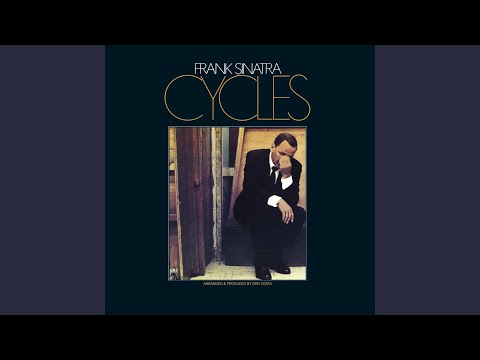
The late 1960s were a period of genuine creative renewal for Sinatra, a period in which he found material that allowed him to comment on the human condition with the authority of a man who had actually lived through the kinds of losses and recoveries the songs described. "Cycles" became one of the signature songs of this phase, a piece that fans who had followed him since the bobby-soxer years found newly resonant, and one that could reach younger listeners who were drawn in by the universality of its emotional subject matter. The album of the same name, Cycles, performed well commercially, confirming that the direction was the right one. Press play and hear what true resilience sounds like in the voice of a man who had earned the right to sing about it.
"Cycles" — Frank Sinatra's singular moment on the 1960s charts.
02 Song Meaning
"Cycles" — Endurance, Time, and the Philosophy of Starting Over
The Wisdom of Persistence
At its core, "Cycles" is a song about a very specific kind of emotional wisdom: the understanding that difficult periods in life are not permanent, that seasons change and moods shift and the human capacity for recovery is more resilient than despair makes it feel in the moment. The lyric does not pretend that hardship is easy to bear or that optimism arrives naturally when things go wrong. Instead, it acknowledges the weight of loss and struggle honestly, and then makes the case for continuing anyway. This is the message that Sinatra made entirely his own, drawing on decades of public and private experience to lend the sentiment genuine gravity.
Time as the Organizing Metaphor
The cyclical imagery embedded in the song's title and lyrical structure is doing significant philosophical work. Cycles, by definition, are patterns of recurrence: they imply that what has passed will come around again, that winter is followed by spring, that endings contain within them the seeds of beginnings. This is one of the oldest forms of consolation in human culture, found in ancient philosophies and religious traditions across the world, and the song taps into that deep reservoir of meaning without becoming pretentious or over-reaching. It keeps the metaphor grounded in everyday emotional experience, which is precisely what makes it work as a pop song rather than a philosophical treatise.
Sinatra's Credibility with the Material
What elevated "Cycles" beyond a merely competent adult-pop recording in 1968 was the specific credibility Sinatra brought to it. He had experienced spectacular public failures alongside his successes, had navigated career low points and personal upheavals that would have finished lesser artists, and had come back stronger on multiple occasions. When he sang about getting through the bad times, audiences understood that the sentiment was not abstract but grounded in experience visible in the public record. That biographical resonance is not strictly necessary for a song to work, but when it aligns with the material as precisely as it did here, it transforms the recording into something richer than the sum of its parts.
The Cultural Moment and the Universal Theme
In 1968, a year that tested American society's capacity for resilience in almost every possible way, the song's themes had an unusual public dimension. The country was grieving multiple assassinations and processing the ongoing trauma of a deeply unpopular war. A song about enduring hard times and trusting that conditions would change was speaking, consciously or not, to something much larger than individual emotional experience. Sinatra was not a political artist in any narrow sense, but great art has always been capable of carrying more meaning than the artist explicitly intends, and "Cycles" found audiences ready to hear its message on multiple levels.
Lasting Resonance
The song has continued to find listeners in the decades since its original release, partly because Sinatra's voice is timeless and partly because the emotional proposition the song makes remains permanently relevant. Loss and recovery are not historically specific experiences; they belong to the permanent human condition. A meditation on those themes, delivered with the kind of craft and conviction that Sinatra brought to everything he recorded, is the kind of thing that ages into permanence rather than irrelevance.
→ More from Frank Sinatra
View all Frank Sinatra hits →


→ More from the 1960s File
View all 1960s hits →



Keep digging