The 1960s File Feature
Hello Walls
Hello Walls: Faron Young and the Song That Made Willie Nelson Famous In the spring of 1961, a twenty-eight-year-old Texas songwriter named Willie Nelson was …
01 The Story
Hello Walls: Faron Young and the Song That Made Willie Nelson Famous
In the spring of 1961, a twenty-eight-year-old Texas songwriter named Willie Nelson was struggling to make ends meet in Nashville. He had arrived in the city a couple of years earlier with a guitar, a handful of original compositions, and the kind of stubborn belief in his own talent that borderline poverty rarely dims. The song he had written, a deceptively simple meditation on loneliness addressed directly to the walls, windows, and ceiling of an empty room, would change his financial circumstances overnight and set the stage for one of the most durable careers in American popular music. The vehicle for that transformation was Faron Young, a Louisiana-born country star already well established as one of Nashville's most commercially reliable acts.
Young heard the demo and recognized something in it immediately. The conceit of speaking to inanimate objects rather than narrating heartbreak in conventional verse was unusual enough to stand out in a market flooded with heartache songs, yet the emotional logic was instantly comprehensible to anyone who had ever rattled around a house after someone left. He recorded the track with the polished, mid-tempo production that Capitol Records favored for country releases of the period, and the result was a record that sounded simultaneously effortless and precise.
Released in April 1961 on Capitol Records, "Hello Walls" reached number one on the Billboard Hot Country Singles chart, where it remained for a remarkable run that cemented Young's status at the top of the format. The song's crossover appeal was equally impressive. It climbed to number twelve on the Billboard Hot 100 pop chart, a crossover performance that was far from guaranteed for a Nashville production in that era, when country music was still treated by many pop radio programmers as a regional curiosity rather than a legitimate commercial category.
The production bore the hallmarks of the Nashville Sound that producer and industry architect Chet Atkins and others were refining during this period. Smooth string arrangements softened the harder edges of honky-tonk, and the overall sonic palette aimed at radio-friendliness without sacrificing the emotional directness that country audiences demanded. Young's delivery was characteristically confident, carrying a hint of theatrical anguish that suited the song's slightly absurdist premise without tipping into self-parody.
The royalty check Nelson received for "Hello Walls" reportedly amounted to around $10,000, which in 1961 represented a life-changing windfall for a writer who had been moonlighting as a disc jockey in Fort Worth to pay his bills. That money allowed Nelson to focus entirely on his songwriting and to begin establishing himself in Nashville's music publishing community. The success also opened doors for him as a recording artist in his own right, though his most commercially dominant years as a performer still lay more than a decade in the future.
Young had scored hits before and would continue to do so throughout the 1960s, but "Hello Walls" became the defining record of his middle career, the song most likely to appear alongside his name in retrospective coverage and chart histories. Its success also accelerated interest in Nelson as a songwriter, and within a remarkably short period he had placed songs with Patsy Cline, Ray Price, and Billy Walker, establishing himself as one of the most gifted tunesmiths operating out of Music Row.
The broader cultural context of 1961 country music is worth noting. The format was in the midst of a complicated transition. The raw emotional directness of honky-tonk, pioneered by Hank Williams in the late 1940s and early 1950s, was being smoothed over by the Nashville Sound's emphasis on professional pop production, and some purists resented what they saw as a dilution of the music's working-class authenticity. "Hello Walls" navigated this tension shrewdly. Its sophisticated conceit and clean arrangement satisfied pop radio requirements, while its subject matter, the physical reality of an empty house and the psychological weight of absence, remained rooted in the emotional territory country music had always claimed as its own.
The song spent twenty-three weeks on the Billboard country chart, an extended run that reflected genuine listener attachment rather than mere novelty. Radio programmers returned to it repeatedly, and jukebox play in roadhouses and diners kept it circulating long after its initial chart peak.
Decades later, "Hello Walls" continues to appear in surveys of essential country songwriting, cited not merely as a career milestone but as an early demonstration of Nelson's instinct for finding unexpected emotional angles on familiar experiences. It is regularly performed at tribute concerts and has been covered by dozens of artists across multiple genres. Its place in the history of Nashville songwriting is secure, and its role in making Willie Nelson financially solvent enough to pursue his artistic ambitions remains one of the more consequential transactions in the music's history.
02 Song Meaning
The Ache of Empty Rooms: What "Hello Walls" Is Really About
The central device of "Hello Walls" is one of the more quietly inventive conceits in country music songwriting. Rather than addressing a departed lover directly, or narrating the fact of her absence to a neutral listener, the song's speaker turns to the physical environment of the home itself, speaking to walls, windows, and a ceiling as though these surfaces share his loneliness and can be expected to understand it. The effect is both comic and genuinely poignant, because the very absurdity of the gesture captures something true about what extreme loneliness feels like: the world contracts until even inanimate objects seem like better company than the silence.
Willie Nelson wrote the song during a period when he was intimately acquainted with financial precarity and the particular isolation of being far from home without the resources to change that fact quickly. Whether or not the song draws directly on personal experience, it carries the weight of authentic observation. The speaker is not wallowing in self-pity; he is making a wry, slightly rueful acknowledgment that he has arrived at a strange place psychologically, talking to the furniture, and he knows it. That self-awareness gives the song a dimension of humor that prevents it from curdling into pure sentimentality.
The lyrical structure follows a pattern of address and anticipation, with the speaker asking the walls to help him make it through until his lover returns. There is an implicit assumption that she will return, which distinguishes the emotional register of the song from straightforward heartbreak material. This is not a song about permanent loss; it is a song about the suspended animation of waiting, and the strange mental tricks a person plays on themselves to get through that time. Speaking to walls is one such trick, and Nelson frames it with enough self-deprecating clarity that it lands as recognizable rather than pathetic.
The song belongs to a tradition of country music that takes working-class domestic spaces seriously as emotional environments. The home in American country music is rarely neutral territory. It is the place where relationships are built and dissolved, where loneliness is felt most acutely because the physical surroundings carry the memory of company. Nelson understood this and pushed the convention a step further by making those surroundings active participants in the emotional drama rather than passive backdrop.
For Faron Young, the song represented an opportunity to display a subtler emotional range than straight-ahead honky-tonk permitted. His delivery balanced the comedic premise against genuine feeling with considerable skill, never letting either element overwhelm the other. This tonal balance was part of what made the record so commercially successful: it was accessible to listeners who might not ordinarily seek out country music because its premise could be grasped and appreciated without deep familiarity with the genre's conventions, while its emotional core was authentic enough to satisfy listeners who demanded that authenticity as a condition of engagement.
The meaning of the song also operates on the level of what it says about male emotional expression in early 1960s America. The speaker is not ashamed of his loneliness; he announces it directly, names it, and addresses it to whatever audience is available, even if that audience is plaster and glass. In a cultural moment when male vulnerability was not often presented without irony or deflection, this directness was striking. Nelson's genius was to wrap that vulnerability in a conceit absurd enough to provide cover, so the listener could laugh at the situation while simultaneously recognizing and feeling its emotional weight.
Across the decades, the song has lost none of its resonance. The experience of being alone in a space that feels charged with someone else's absence is universal enough to transcend the specific country music context of its origin, and that universality is the deepest source of the song's durability.
→ More from Faron Young
View all Faron Young hits →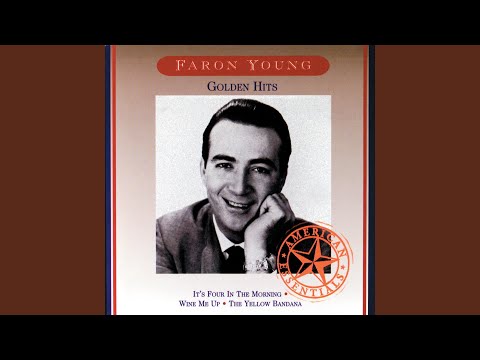

→ More from the 1960s File
View all 1960s hits →




Keep digging