The 1960s File Feature
Bad Moon Rising
Bad Moon Rising: How Creedence Clearwater Revival Captured an Era of American Dread Few songs in rock history have so efficiently bottled an atmosphere of im…
01 The Story
Bad Moon Rising: How Creedence Clearwater Revival Captured an Era of American Dread
Few songs in rock history have so efficiently bottled an atmosphere of impending catastrophe as "Bad Moon Rising," the single that Creedence Clearwater Revival released in the spring of 1969. The track arrived during one of the most turbulent years in American life, when the Vietnam War ground on without visible end, social institutions were cracking under protest and counterculture pressure, and the optimism of the early 1960s felt like a distant memory. CCR front man John Fogerty wrote the song, and in doing so he produced what many critics would later recognize as the defining sound of that historical moment, a deceptively cheerful musical frame containing a lyrical vision of floods, earthquakes, rivers overflowing, and the eye of the hurricane bearing down.
Fogerty has said in interviews that the song's inspiration came partly from the 1941 film The Devil and Daniel Webster, in which a terrible storm portends catastrophic events. He translated that cinematic dread into three minutes of surging roots rock, building a melody so propulsive and upbeat that radio listeners often did not register the darkness in the words until they had already been singing along for weeks. That ironic tension between sound and sense became one of the song's most remarked-upon qualities, a quality that Fogerty and the band deployed with confident, almost casual mastery.
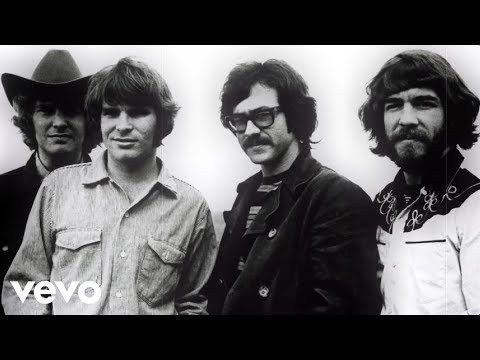
Creedence Clearwater Revival recorded the track at Wally Heider's studio in San Francisco with Fogerty serving as both songwriter and producer. The band at the time consisted of Fogerty on lead vocals and guitar, his brother Tom Fogerty on rhythm guitar, Stu Cook on bass, and Doug Clifford on drums. Their collective sound was tight and economical, shaped by years of playing together since their teenage years in El Cerrito, California. The single was released on April 14, 1969, on Fantasy Records, the Berkeley-based label that had become the band's commercial home. That label relationship was complicated by longstanding disputes over royalties and ownership, but in the spring of 1969 those disputes had not yet reached their full corrosive force.
"Bad Moon Rising" reached number two on the Billboard Hot 100, a chart position that frustrated Fogerty given how dominant the song felt on radio. It was kept from the top spot by Henry Mancini's "Love Theme from Romeo and Juliet," a collision of genres that illustrated the eclectic state of American pop in 1969. The song performed even better in the United Kingdom, where it topped the UK Singles Chart, giving CCR their first British number one. Internationally, the track demonstrated the band's ability to cross demographic and national lines with a directness that few of their San Francisco Bay Area contemporaries could match.
The song appeared on the album Green River, released later that summer in August 1969. Green River itself became a significant commercial success, reaching number one on the Billboard albums chart. CCR's productivity in 1969 was remarkable by any standard. The band released multiple albums that year and maintained a relentless touring and recording schedule that earned them a reputation as one of the hardest-working acts in American rock. "Bad Moon Rising" was the opening declaration of that fertile period, establishing the template of swamp-inflected rock that would define their most celebrated work.
Radio programmers embraced the song immediately. Its runtime of roughly two and a half minutes suited the AM radio format that still dominated American airwaves in 1969, and its instantly memorable opening guitar riff gave DJs a reliable hook they could count on to hold listener attention. The song spent nineteen weeks on the Billboard Hot 100, a chart run that testified to its durability and its broad appeal across demographic groups that often seemed to have little else in common. Young men facing the draft heard something urgent in it. Older listeners heard a throwback to the swamp blues and country rock of an earlier American era. Both readings were valid, which was part of the song's genius.
The cultural footprint of "Bad Moon Rising" extended well beyond its initial chart run. It became one of the most recognizable songs in the CCR catalog, which is itself one of the most recognizable catalogs in American rock history. The track appeared in countless films and television series over the subsequent decades, consistently deployed whenever a director wanted to signal oncoming disaster without resorting to obvious score cues. Its use in An American Werewolf in London in 1981 gave it a new generation of listeners and reinforced its association with malevolent transformation, an association Fogerty likely never fully anticipated but which he acknowledged with dry amusement in later interviews.
From a musicological standpoint, the song is often cited in discussions of how country and rock traditions merged in the late 1960s. Fogerty's guitar work drew explicitly on the vocabulary of country picking and swamp blues rather than the British Invasion or psychedelic sounds that dominated Bay Area rock at the time. That choice made CCR sound unlike almost any of their contemporaries and gave them a timelessness that more fashionable acts from the same period lacked. The song was certified platinum in the United States as certification standards evolved in later decades, confirming what airplay data had long suggested: that it was one of the most frequently heard American singles of its generation.
John Fogerty's authorship of "Bad Moon Rising" became a source of personal frustration for years because of the Fantasy Records dispute, which eventually saw him settle terms that he considered exploitative. For a significant period he declined to perform the song in concert rather than generate royalties for a label he resented. When he did return to performing it, the song always generated an outsized audience response, a reminder that the intervening years had done nothing to diminish its power. It remains one of the essential documents of American rock in the Vietnam era, a two-and-a-half-minute distillation of a nation's unease.
02 Song Meaning
Reading the Dread: The Meaning Behind "Bad Moon Rising"
"Bad Moon Rising" operates on a deceptively simple premise: natural signs, storms gathering at the horizon, rivers swelling past their banks, all interpreted as omens of catastrophe. John Fogerty took a form familiar from folk tradition and country music, the warning song, the omen ballad, and compressed it into a rock format that stripped away any regional or stylistic specificity. The result was a text that listeners in virtually every English-speaking country could hear as directly relevant to whatever crisis they were living through at that moment.
At its core, the song describes a speaker who reads apocalyptic signals in the natural world and addresses a companion or a general audience with urgent advice to take shelter, stay indoors, prepare for the worst. The repeated image of the bad moon is borrowed from folklore traditions that associate lunar phenomena with disaster, a belief so widespread across cultures that it needed no explanation. Fogerty did not invent this symbolism but deployed it with maximum economy, packing the central image with decades of cultural weight in just a few syllables.
The song has been consistently interpreted as a Vietnam War allegory, a reading that Fogerty himself encouraged in interviews while insisting the song was not written with that explicit intention. The convergence was perhaps inevitable. In 1969, American young men of draft age were living with the constant awareness that catastrophe could arrive with a draft notice. The song's warning to seek shelter and prepare for trouble mapped directly onto that existential condition. Radio listeners heard the song as a communal acknowledgment of shared dread, which is precisely why it resonated across demographic groups that seldom agreed on anything.
The ironic gap between the song's musical texture and its lyrical content is among its most discussed qualities. The music is ebullient, driving, almost celebratory in its forward momentum. Fogerty's production choice to frame the ominous text inside an upbeat country-rock arrangement created a cognitive dissonance that deepened the song's emotional impact. Listeners felt the contradiction without necessarily naming it: something cheerful on the surface, something dark underneath. That structure mirrored the lived experience of 1969 itself, a year when ordinary life continued alongside extraordinary violence and social rupture.
For CCR's catalog, "Bad Moon Rising" established the thematic template that would define their most important work. Fogerty returned repeatedly in his songwriting to images of southern American landscape under threat, to ordinary people bracing for forces beyond their control, to the gap between official optimism and lived reality. The song planted that flag clearly and early, signaling to listeners that CCR was not interested in the escapist fantasies or utopian rhetoric that characterized much of their Bay Area contemporaries' output.
The enduring cultural life of "Bad Moon Rising" across films, television series, and commercial uses has reinforced its status as a universal omen text, a piece of music that any director or producer can deploy to signal approaching disaster without explanation. That versatility is a testament to how efficiently Fogerty constructed the song's emotional logic. The track's capacity to function as a legible warning sign across five decades of popular culture is nearly without parallel in the American rock canon. It belongs to that rare category of recordings that have become part of the shared cultural furniture, so thoroughly absorbed into common understanding that their origins and intentions have been replaced by something closer to myth.
→ More from Creedence Clearwater Revival
View all Creedence Clearwater Revival hits →

→ More from the 1960s File
View all 1960s hits →




Keep digging