The 1960s File Feature
I Am Your Man
Bobby Taylor and The Vancouvers: "I Am Your Man" and the Motown Moment Bobby Taylor and The Vancouvers occupy a distinctive place in soul music history that …
01 The Story
Bobby Taylor and The Vancouvers: "I Am Your Man" and the Motown Moment
Bobby Taylor and The Vancouvers occupy a distinctive place in soul music history that far exceeds what their modest chart record might suggest. The group was a biracial ensemble formed in Vancouver, British Columbia, in the mid-1960s, and their signing with Motown Records in 1968 coincided with a period when the label was pushing outward from its Detroit core to absorb new talent from unexpected geographic territories. "I Am Your Man," released in the summer of 1968, represented the group's most significant entry on the Billboard Hot 100 and arrived during one of the most consequential periods in American popular music.
The group's lineup was notable for its racial integration at a moment when such mixing in American popular music remained culturally significant. Bobby Taylor, an African American singer from Washington, D.C., served as the lead voice, while the backing group included musicians of different racial backgrounds. In 1960s America, a racially mixed act signed to Motown carried a set of implications that extended beyond the music itself. The label's founder, Berry Gordy Jr., had long understood that crossover appeal required not only musical excellence but also careful management of the cultural signals that a group projected.
Taylor came to Motown with strong roots in the rhythm and blues tradition and a vocal style that could accommodate both raw emotion and polished studio presentation. The Vancouvers provided tight, responsive accompaniment that fit comfortably within the Motown production template while retaining something of the looser energy that had characterized their club performances on the West Coast. The combination gave "I Am Your Man" a sound that was simultaneously recognizable as Motown product and slightly distinct from the label's more polished Detroit sound.
The single debuted on the Billboard Hot 100 on August 10, 1968, at number 92. It rose to number 85 the following week and held that position for a third week before falling from the chart, a performance that reflected solid regional enthusiasm without the national breakthrough the group had hoped for. The chart showing was modest by the standards of Motown's biggest acts but respectable for a relatively new signing working to establish name recognition in a competitive environment.
What made Bobby Taylor and The Vancouvers historically significant went well beyond their own chart performance. Earlier in 1968, Taylor had encountered a group of young performers from Gary, Indiana, during a show at the Regal Theater in Chicago. He was struck by their talent and brought them to the attention of Berry Gordy, who signed them to Motown. That group was the Jackson 5, and Taylor's role in their discovery and early development constituted one of the pivotal moments in popular music history. He worked with the young Jacksons during their formative period at the label, helping to shape the sound and approach that would eventually make Michael Jackson one of the most successful recording artists of the twentieth century.
This discovery overshadowed Taylor's own recording career in the public memory, but it did not reflect his full contribution to the period. His work as a performer and producer demonstrated a genuine musical intelligence, and "I Am Your Man" captured that intelligence in concentrated form. The song moved with the confident rhythmic drive that characterized the best Motown output of the late 1960s, with Taylor's vocal asserting itself over a tight arrangement that left room for the kind of phrasing flexibility that distinguished the best soul singers from their merely competent peers.
The Motown studio infrastructure that shaped the recording was among the most sophisticated in American popular music at the time. The label's in-house musicians, known informally as the Funk Brothers, provided the rhythmic and harmonic foundation that gave Motown records their characteristic feel. Working within that system, Bobby Taylor and The Vancouvers produced a record that honored the label's established aesthetic while demonstrating that distinctive voices could emerge from territories far removed from Detroit's musical ecosystem.
Their tenure at Motown was relatively brief, and subsequent decades found Taylor moving through various phases of his career without recapturing the commercial profile of the 1968 period. But the combination of "I Am Your Man" and the discovery of the Jackson 5 ensured that his contribution to soul music history was durable and meaningful, even if it was not always fully credited in the broader popular narrative.
02 Song Meaning
The Meaning of "I Am Your Man": Devotion and Masculine Commitment in Soul Music
"I Am Your Man," as performed by Bobby Taylor and The Vancouvers in 1968, belongs to a well-established tradition of soul music declarations in which the male narrator positions himself as the singular, irreplaceable partner for the woman he addresses. The directness of the title phrase is itself meaningful: not "I want to be your man" or "I could be your man," but a flat, present-tense declaration of existing status. The narrator is not making a proposal; he is asserting a fact about the relationship as he understands it.
This declarative mode was central to late-1960s soul music's emotional vocabulary. Artists across the Motown and Stax rosters routinely framed romantic commitment in terms of capacity and reliability — the ability to provide, protect, and remain constant under pressure. The assertion "I am your man" participated in that vocabulary while also carrying a specific cultural weight within the African American community of the era. Manhood and its responsibilities, the right to claim emotional and domestic authority, the assertion of dignity in intimate relationships: these were not merely personal themes but socially freighted ones in 1968 America.
Bobby Taylor's vocal delivery on the track reinforced the lyric's directness. His voice carried the kind of earnest conviction that made declarations of this type sound less like boasting than like genuine testimony. The difference is crucial: a singer who simply asserts dominance produces a record that can feel aggressive or hollow, while a singer who communicates genuine commitment alongside that assertion produces something that audiences can believe and embrace. Taylor's phrasing belonged firmly in the second category.
The soul music tradition from which "I Am Your Man" emerged was built partly on the paradox that vulnerability and strength could coexist in the same vocal performance. The narrator's declaration of commitment is implicitly also an expression of need: to be "your man" is to require someone to be "your man" for. This mutual dependency, dressed in the language of masculine assertion, gave the best examples of the genre an emotional complexity that went beyond the surface swagger of the lyrics.
The Motown context shaped how the song's meaning was received. The label's productions were designed to cross racial and demographic boundaries, and "I Am Your Man" carried that crossover intent in its production choices. The arrangement was polished enough to appeal to pop radio audiences while retaining enough rhythmic directness to satisfy soul listeners. This balancing act was itself ideologically loaded: Motown's crossover strategy represented a claim that African American popular music could and should reach the broadest possible audience on its own terms.
Bobby Taylor's place in the song's meaning was also inflected by his own position as a biracial group's frontman during a period of intense racial tension in the United States. The year 1968 saw the assassination of Martin Luther King Jr., widespread urban unrest, and deeply contested political battles over civil rights legislation. A song that asserted masculine dignity and romantic commitment in that environment was not simply a pop record; it was an act of cultural self-definition. The claim "I am your man" resonated with the broader assertion of identity and worth that animated much of the most significant soul music of the period.
The song's emotional simplicity was one of its strengths. It did not attempt to complicate the central declaration with qualification or ambivalence. The narrator knew who he was and what he offered, and he wanted the woman he addressed to know it too. That clarity, delivered with Taylor's vocal sincerity and the Vancouvers' tight backing, produced a record whose meaning was immediately accessible while remaining rooted in a specific historical moment and its particular emotional demands.
→ More from Bobby Taylor & The Vancouvers
View all Bobby Taylor & The Vancouvers hits →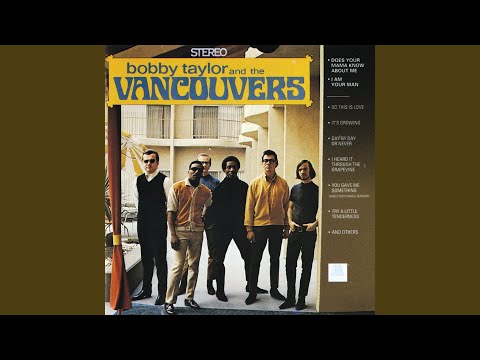
→ More from the 1960s File
View all 1960s hits →




Keep digging