The 1950s File Feature
The Three Bells
The Three Bells: How The Browns Conquered Both Nashville and New York in 1959 "The Three Bells" stands as one of the most remarkable crossover achievements o…
01 The Story
The Three Bells: How The Browns Conquered Both Nashville and New York in 1959
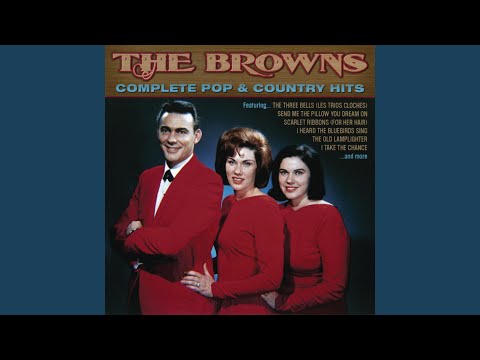
"The Three Bells" stands as one of the most remarkable crossover achievements of the entire pre-Beatles era, a record that bridged the gap between country music and mainstream pop at a time when those two worlds operated with very little overlap. The Browns, a sibling harmony group from Pine Bluff, Arkansas, recorded the English-language adaptation of a French song and sent it to the top of charts that were rarely shared between Nashville and New York. Its journey from regional act to national phenomenon remains one of the most instructive stories in the history of American popular music.
The original song was a French composition called "Les Trois Cloches," written by Jean Villard Gilles in the 1930s and associated most closely with the French singer Edith Piaf, who recorded it as part of the vocal duo Les Compagnons de la Chanson. The song traces the life of a man named Jimmy Brown from his birth through his marriage and finally to his death, with the church bells marking each transition. Bert Reisfeld wrote the English-language lyrics that The Browns recorded, adapting the continental ballad for an American country audience while preserving the episodic structure and the central metaphor of the bells tolling through the seasons of a life.
The Browns recorded "The Three Bells" for RCA Victor, the label that had been the home of country royalty including Eddy Arnold and, most consequentially, Elvis Presley. Jim Ed Brown and his sisters Maxine and Bonnie had been recording for RCA Victor since the mid-1950s, building a reputation for lush, harmonically sophisticated vocal work that owed as much to gospel and the close-harmony traditions of the rural South as it did to the Nashville Sound emerging around producer Chet Atkins.
Released in the summer of 1959, the record reached number one on the Billboard Hot 100, spending a remarkable seven consecutive weeks at the top of the chart. This was an extraordinary run for any record in that era, when the pop charts were crowded with teen idols and the emerging rock and roll sound that had reshaped popular taste since 1955 and 1956. For a country harmony group to dominate the pop chart for nearly two months was an achievement without obvious precedent, and it placed The Browns alongside a very small group of country acts who had managed to cross over without fundamentally altering their sound.
The record simultaneously reached number one on the Billboard country charts, making The Browns one of the rare acts to hold the top position on both major charts simultaneously. The country and pop markets had divergent tastes and largely distinct radio infrastructures at this point in history, so this kind of double dominance required a record that spoke genuinely to both audiences, which "The Three Bells" managed through its combination of melodic simplicity, harmonic richness, and a story with universal emotional appeal.
The production, shaped within the Nashville Sound aesthetic that was bringing string arrangements and polished studio technique to country recordings, gave the record a quality that pop radio programmers found accessible. Chet Atkins, who was the architect of the Nashville Sound and a key figure at RCA Victor's Nashville operations, understood how to smooth the rougher edges of country production without eliminating its warmth, and the record benefited from that institutional knowledge.
The song spent ten weeks at number one on the country airplay chart, an even longer run than its pop chart tenure, confirming that the core country audience had claimed the record as their own even as it crossed into the mainstream. Year-end chart compilations for 1959 ranked it among the biggest records of the year across all genres, a distinction that the pop and country trades both acknowledged in their retrospective coverage.
The Browns rode the record's success to television appearances and concert bookings that had previously been beyond their reach, including slots on programs that reached national audiences. The visibility the song generated proved difficult to sustain over subsequent releases, which was the common fate of acts who achieved a single transcendent crossover hit without the machinery to follow it, but the record itself retained its cultural resonance for decades. It became a standard of mid-century American music, covered by numerous artists and referenced in retrospectives on the era as a defining example of what country music could achieve when its traditional strengths of vocal harmony and emotional storytelling were delivered with enough polish to reach the broadest possible audience.
Maxine Brown, who had been the dominant lead voice of the group and whose higher register carried much of the song's melody, later spoke about the recording session as a relatively straightforward studio date that gave no indication of the cultural earthquake it was about to produce. That distance between the apparent simplicity of the recording and the enormity of its commercial impact is itself part of the story, a reminder that the records that define eras are not always the ones conceived with that ambition.
02 Song Meaning
The Meaning of "The Three Bells": A Life Measured in Church Peals
"The Three Bells" works through one of the most ancient structural devices in storytelling: the life cycle compressed into three moments. Birth, marriage, death, each announced by the same bells in the same village, constitute the entire arc of Jimmy Brown's existence as the song presents it. The simplicity of this framework is not a limitation but a deliberate choice, one that allows listeners to project their own lives onto the template and find it fitting. The universality is the point. Jimmy Brown is everyman, and the bells are the shared punctuation of any life lived within a community.
The church bells themselves carry the song's deepest symbolic weight. They function as both a literal sound and a metaphor for the way communities mark and share their members' transitions. The bells do not editorialize; they simply ring, which gives them a neutrality that the song treats as a form of grace. No life is too small to be noted. No passage goes unremarked. In a mid-century American country context, this spoke directly to audiences in small towns and rural communities who understood intuitively what it meant to have one's life contained within the sound of a single church's bells.
The original French composition by Jean Villard Gilles carried a distinctly European sensibility, rooted in the Catholic tradition of village life where the church sat at the center of communal existence. Bert Reisfeld's English adaptation retained the essential structure while Americanizing the register, making it accessible to a Protestant country audience without losing the sense of sacred time that gives the original its weight. The result is a song that sits between traditions, inheriting something from both its French origins and its country presentation.
For The Browns, the song's emotional register matched their vocal strengths perfectly. Sibling harmony carries its own implicit message about family, continuity, and belonging, and when Jim Ed, Maxine, and Bonnie Brown sang about a life moving from birth to death within a community, their shared bloodline added a layer of authenticity that no assembled studio group could have replicated. Their RCA Victor recording capitalized on this alignment between the song's themes and the ensemble's personal configuration in ways that were almost certainly felt by listeners even when they were not consciously articulated.
The song's treatment of death is notably gentle, almost welcoming. Jimmy Brown's passing is presented not as a tragedy but as a completion, the final bell marking the close of a full life rather than a life cut short. This consolatory approach to mortality was a staple of gospel-inflected country music in the 1950s, a tradition that drew on Christian frameworks of death as transition rather than termination. For audiences in 1959, many of whom had lived through World War II and the Korean War and had their own reasons to think about death's presence in ordinary life, the song's refusal of anguish in favor of acceptance offered a particular kind of comfort.
The record's seven-week run at the top of the Billboard Hot 100 confirmed that its themes transcended the country audience for which it was nominally made. Pop listeners who might never have picked up a country album found something in the song that met them where they were, which suggests that the life cycle narrative operates at a register below genre preference, in the territory of shared human experience that predates any particular musical tradition.
In the decades since its release, "The Three Bells" has retained its status as one of the signature recordings of mid-century country music, regularly cited in discussions of the genre's capacity for emotional depth and narrative economy. Its meaning was not controversial or complex but simply and durably true, which may be the hardest kind of artistic achievement to sustain across generations.
→ More from The Browns
View all The Browns hits →
→ More from the 1950s File
View all 1950s hits →




Keep digging